Social media scams: how brands fight back in 2026

Social media scams cost victims $2.1 billion in 2025, and your brand's name is usually the bait, not the target. See the six attack patterns hitting business accounts, from takeovers to fake crypto pitches, and what to do the moment a scammer starts wearing your logo.
A lot of brands treat scams as a customer problem. Something that happens to their followers, not to them. Because of this, their inbox fills up with complaints about orders that never shipped, and the assumption is that a shopper got careless somewhere out there.
This happens because scammers rarely create a new brand from scratch. They pretty much always borrow one that people already trust, which means that your logo, your handle, and your comment section become the delivery system.
That’s why in this post we’ll cover what social media scams look like from the brand side, the six patterns that show up on brand and creator accounts, how scammers get in, what to do when your name is being used, and how to stop the cycle before it repeats.
What are social media scams?
Social media scams are fraud schemes that use platforms like Instagram, Facebook, TikTok, and X to trick people into sending money, sharing credentials, or clicking malicious links.
The definition most people know describes the victim's side of the attack. A person gets tricked, loses money, and files a report. However, brands sit on the other side of that same attack. Scammers need a trusted name to make the pitch work, and yours is often the one they pick. That’s why you need to pay attention to protect your online presence.
Why social media scams should worry your business
The sad reality is that social media scams hit business performance, not just customers. When your name is attached to a scam, the losses your followers report get associated with you. As a result, the trust you spent years building drops faster than any ad campaign can rebuild.
Here are some things you should consider:
- Nearly 30% of people who reported losing money to a scam in 2025 said it started on social media, with reported losses reaching $2.1 billion (FTC, April 2026).
- Social media produced higher losses than any other contact method scammers used, and reported losses are roughly eight times the 2020 figure.
- More people reported losing money to scams on Facebook than any other platform, followed by WhatsApp and Instagram.
- Business impersonation drove a heavy share of the damage, with people reporting nearly $1 billion lost to business impersonators in 2025 (FTC, June 2026).
Ask yourself this: When a follower loses money to an account wearing your logo, who do they blame?
But don’t worry, there is good news. Most of these scams follow patterns you can spot and shut down.
Types of social media scams targeting brands and creators
There are six scam patterns showing up again and again on brand and creator accounts. Knowing which is which shortens your response time and tells you where to invest first.
1) Account takeover scams
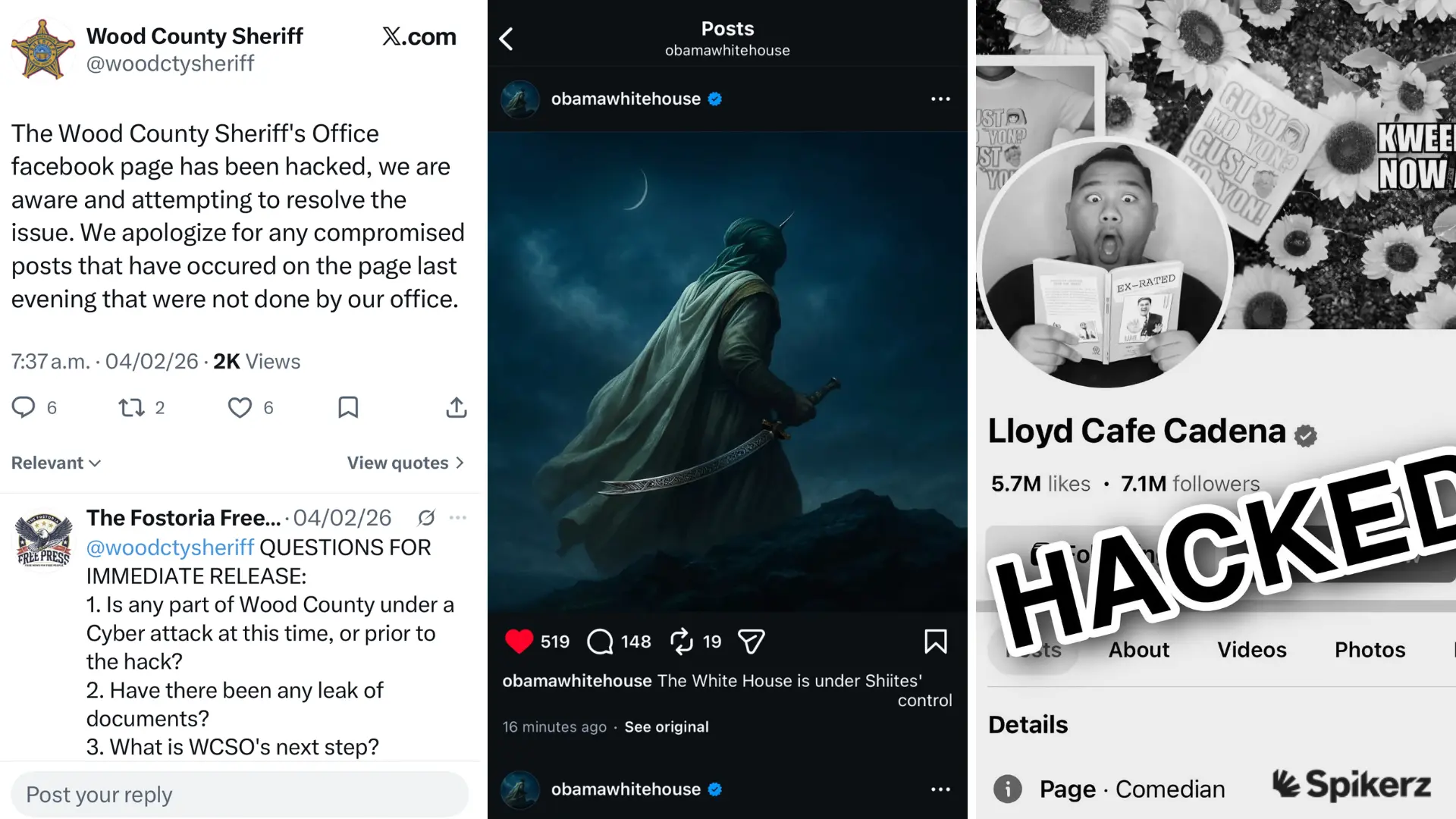
An account takeover happens when someone gains control of your social media account without your permission and uses it to post, message, or run ads under your name. Hackers rarely break into the platform. Instead, they borrow a login, usually through shared credentials, a reused password, or a 2FA code passed around on Slack, email or WhatsApp.
For example, a marketing manager sends the Instagram login and 2FA code to a freelance editor over chat. Weeks later, someone screenshots the message from an old thread and logs in from another country. After that, the page runs a fake crypto giveaway for six hours before anyone on the team notices.
By the way, that example is something that’s actually happened. We’ve reported on similar situations before:
- What the Scott Simon X Hack Teaches Us About Brand Security
- Why Trusted Brands Are The Biggest Target on X Right Now
- Pro Golfer's 621K Followers Hit by Crypto Scam
- What the NBA X Hack Teaches Us About Brand Security
Thankfully for you, our account takeover protection shuts down this door by hosting 2FA in one secure place, so codes never live in a chat again.
2) Brand impersonation scams
Brand impersonation is when a scammer creates a social account that copies your name, logo, and posts to trick your audience into thinking it belongs to you. Attackers use the profile to run fake discounts, fake shops, or fake support to turn your audience into their victims.
For example, a fake account with a handle one underscore off from yours reposts your product photos and advertises a 70% flash sale. Followers then click through to a checkout page that looks like yours, enter their card details, and never see a package. And after that, your customer service team then spends two weeks explaining refunds you never owed.
Consider this: Shopping scams were the most reported social media scam of 2025, with more than 40% of victims saying it started with something they saw in an ad. For a deeper look at the takedown side, read our post on what social media impersonation is and how to prevent it.
3) Executive impersonation
Executive impersonation (also called whaling) is when a scammer creates a fake profile of a senior leader like a CEO or founder and uses it to reach out to employees, partners, or fans. The pitch usually asks for a payment, a gift card, an investment tip, or a login.
For example, a fake profile of your CEO messages a junior finance employee on LinkedIn, requesting a wire transfer to close a confidential acquisition. The employee has never met the CEO in person and hesitates but pays. By the time the real CEO hears about it, the money is gone and the fake account has messaged twelve more people on the team.
This unfortunately happens often (it’s become more common because of AI). Here are some guides to help protect you:
- How to Mitigate Social Engineering Attacks
- Top 5 Social Media Safety Threats & How to Prevent Them
- How To Protect Your Business From AI Impersonation
- AI Moderation Deep Dive: How Spikerz Detects Hate, Spam & Impersonators
4) Phishing DMs and fake platform emails
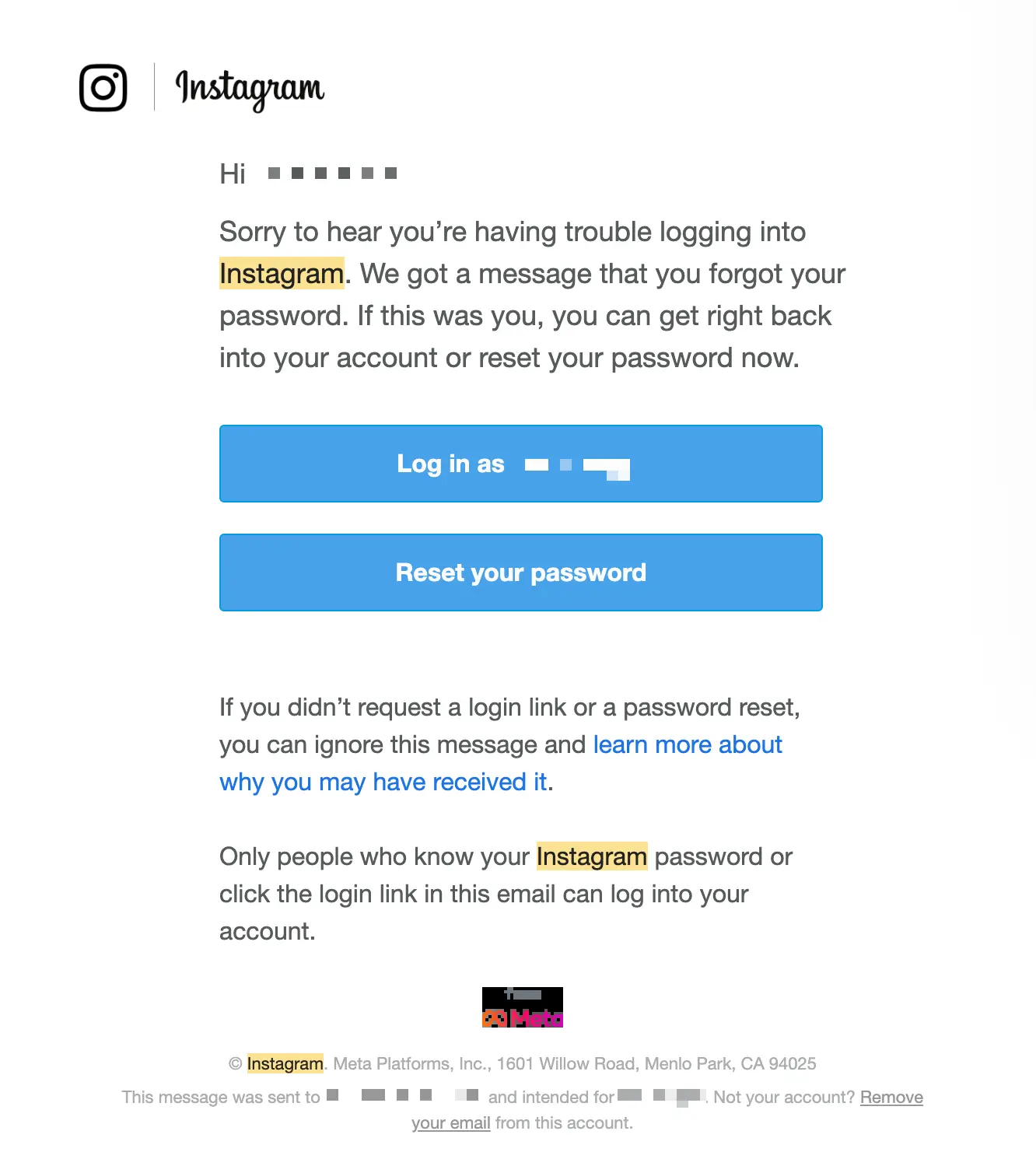
Social media phishing is when a scammer sends messages designed to steal your login, your 2FA code, or your payment details by pretending to be someone you trust. Your team will meet two versions most often: the copyright or community guidelines violation email that appears to come from the platform, and the DM offering verification or a brand partnership.
For example, an "Instagram Support" email tells your social media manager the account will be deleted in 24 hours unless they confirm ownership. The link opens a page that looks like Instagram's login and captures the password and 2FA code the manager types in. Within minutes, someone in another timezone is running the account.
Thankfully for you, our phishing protection filters these messages out of your social inbox and DMs before your team ever sees them.
5) Comment section scams
Comment section scams are fraud attempts posted as replies under your posts, usually pretending to be your brand or your support team. Bots reply under your posts posing as customer service, sending followers to fake recovery pages, giveaways, and/or payment links.
These comments sit under your paid posts too, so your ad budget often carries the scam. Because of this, every dollar you spend to reach a new customer pushes the scammer's link in front of them at the same time.
Thankfully for you, our comment moderation tool removes these replies across more than 25 languages, so the fake support account never gets a chance to answer first.
6) Investment and crypto scams run through your audience
Investment and crypto scams promise high returns, exclusive tokens, or celebrity-backed opportunities. Investment scams accounted for $1.1 billion of 2025 social media losses, more than half the total.
For example, a common scenario we see is a hacked fitness brand account posts a story about a new founder's coin with a link to buy in. Hundreds of followers then send crypto to a wallet that empties within the hour, and the brand spends the next month issuing statements and answering angry DMs.
How scammers get in
Entry points are almost always the same:
- Shared passwords and 2FA codes sent over chat apps
- Former employees, freelancers, and agencies who still hold access
- Personal accounts of team members with admin rights
- Phishing emails aimed at the person who manages the page
- Old third-party apps and integrations nobody reviewed
Every one of these issues is an access problem, not a platform problem. So go ahead and review who has access to your accounts. If you need help, our permissions management shows every user with access to every account in one dashboard, and lets you revoke it the moment someone leaves.
What to do when a scam uses your brand
Here are four steps you need to follow:
1) Lock down your accounts first
Confirm the real account is still secure before chasing the fake one. Check active sessions, admin lists, recovery emails and phone numbers, and remove anything that does not belong.
2) Document everything
Collect screenshots, profile URLs, post links, and proof of ownership like trademark records. Platforms decide these cases on evidence, so a thin report gets a slow answer.
3) Report it to the platform
Submit takedown requests through each platform's impersonation or brand form. Timelines vary by platform, so expect a wait and keep the case reference for follow-up.
4) Warn your audience
Post a short notice naming the scam and pointing followers to the real handle. This cuts the scammer's conversion rate while the takedown moves through the queue.
How to stop social media scams before they spread
Reporting scams one at a time is a losing game. Take one down and two more appear by the weekend. Instead, use monitoring that never sleeps.
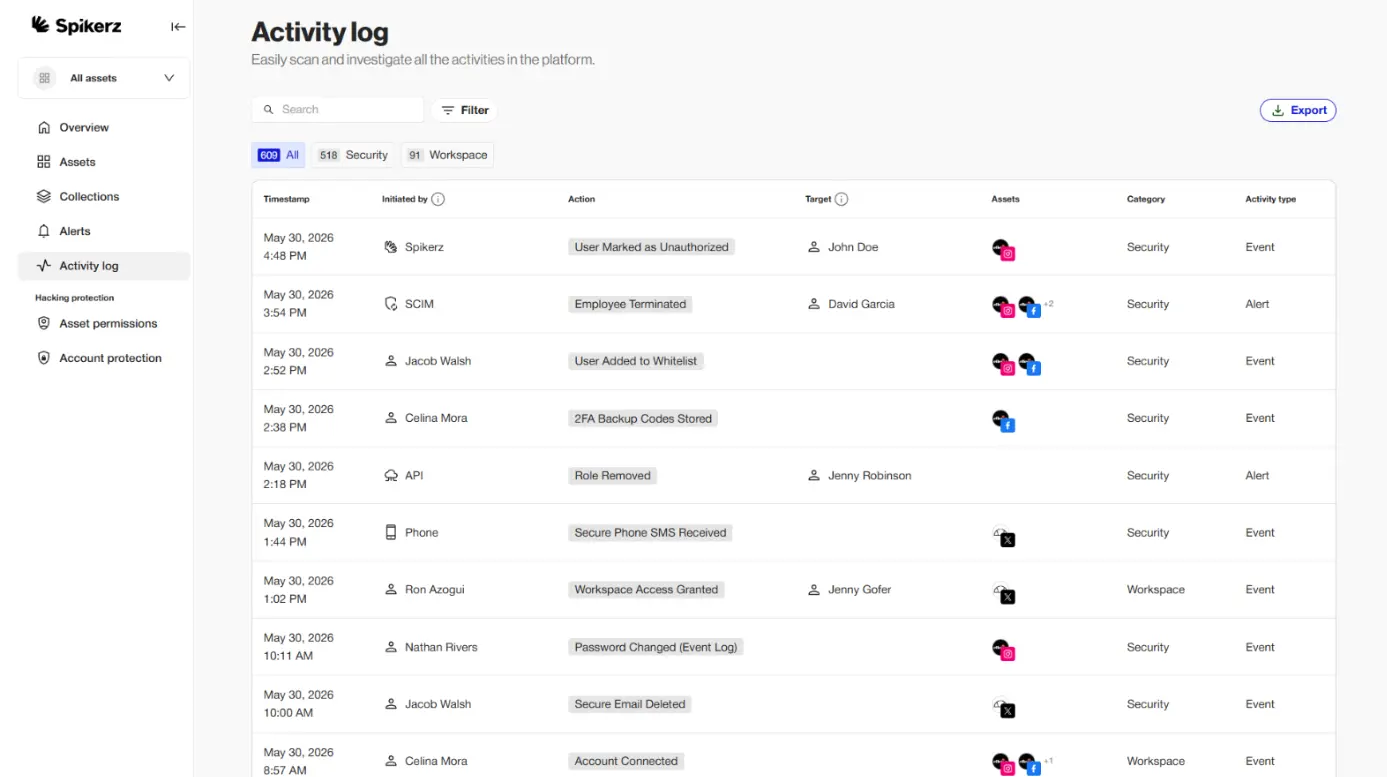
Spikerz is a social media security platform that connects through official APIs in three clicks, with no passwords or credentials shared. We help brands and creators catch scams the moment they appear, and our takedown workflow removes impersonators from the major platforms.
Here’s what we cover:
- Account takeover protection: Ends shared credentials with secure logins and hosted 2FA that your whole team can use.
- Impersonator takedown: Finds fake profiles with AI detection and runs the takedown process for you.
- Phishing protection: Filters phishing emails, DMs, and links before they reach your team or followers.
- Comment moderation: Removes scam comments, bots, and hate in real time across more than 25 languages.
- Permissions management: Shows every user with access to every account and revokes it the moment someone leaves.
Want to see how many hours a week your team gets back once the scam cycle stops repeating?
Your accounts stay yours, your followers stay safe, and your team keeps posting. Book a consultation right now and we will walk you through the platform.
Conclusion
Social media scams stopped being a customer problem the moment scammers realized they could take over your reputation for free. Every account takeover, impersonated profile, whaling attempt, phishing DM, spam comment, and fake investment pitch runs on the trust you built with your audience.
The good news is that there are things you can do to protect your business. Here’s a summary of what you should do:
- Lock down who can log in.
- Watch what happens under your posts.
- Move fast when your name appears on an account you do not own.
That is the work. If you need help, we can do it for you every hour of every day. Your followers don’t need to guess whether the account they are looking at is real, and your team doesn’t need to spend another Monday morning cleaning up a weekend takeover.