What the Scott Simon X Hack Teaches Us About Brand Security

.webp)
Summary:
Crypto scammers hijacked NPR host Scott Simon's X account in seconds, echoing hacks at Mandiant and Linus Tech Tips. Modern attackers skip passwords entirely, using phishing and session token theft to bypass MFA. Here's how to close the gaps: authenticator apps, access audits, and a crisis plan.
Picture this: One day you're a beloved, award-winning NPR host with millions of listeners. The next, your account is locked down, hijacked by crypto scammers pumping fake tokens to your audience.
That's exactly what happened to Scott Simon on March 29, 2026. If a hack like this can hit a high-profile media veteran with one of the largest broadcasters in the country backing him, it can happen to your business too.
Here is how it happens, why it hurts, and how to stop it before your brand becomes the next cautionary tale.
TLDR:
Scott Simon spent 17 years building his NPR brand and then, crypto scammers hijacked his X account in seconds.
This type of attack isn't new. It's happened to Mandiant, Linus Tech Tips, and now it's happened to a NPR veteran, which means it can happen to your business too, no matter your size.
The good news is that there are things you can do to protect yourself. It all starts with discipline:
- Ditch SMS 2FA for authenticator apps
- Audit your third-party integrations
- Document a crisis playbook
But discipline alone won't protect a marketing team sharing passwords in Slack, which is where Spikerz comes in with unified access control, enterprise 2FA, real-time monitoring, and instant lockouts.
Your audience trusts you, so make sure the next message they see actually comes from you.
What Happened To NPR's Scott Simon's X Account?
On March 29, Scott Simon, the long-running host of NPR's Weekend Edition Saturday, found his X account hijacked by crypto scammers. Attackers used his trusted handle to push fake cryptocurrency tokens to his followers, leveraging his decades of cultivated credibility to legitimize a scam.
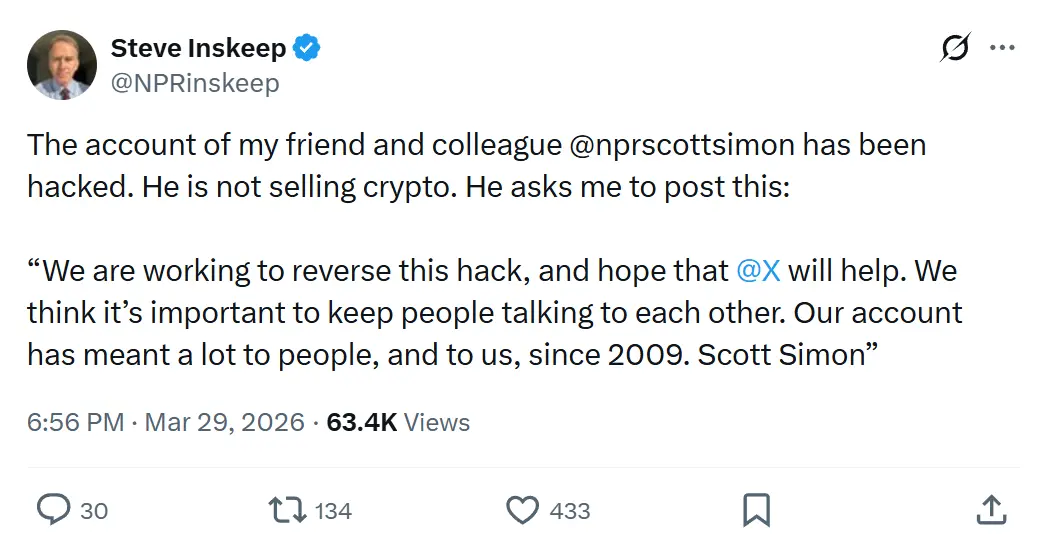
His colleague Steve Inskeep posted a public statement on X confirming the breach, writing that NPR was "working to reverse the hack of Scott Simon's account" and warning followers not to engage with any posts coming from it. You can read the full breakdown of the incident here.
How Do Modern Hacking Tactics Work?
Modern hackers rarely sit around guessing passwords. Brute force is slow, noisy, and most platforms block it within seconds.
Instead, attackers lean on social engineering, phishing links, and session token theft. These tactics walk right around traditional security walls, including multi-factor authentication. As a result, a well-crafted phishing email or a single click on a malicious file can hand over the keys to an entire account without the hacker ever needing your actual password.
Take Linus Tech Tips as a real-world example. In 2023, one of the largest tech YouTube channels in the world got taken over not through a stolen password, but through session token theft. An employee opened what looked like a routine sponsorship PDF, malware extracted the session cookies straight from the browser, and the attackers bypassed both the password and the MFA to seize the channel within minutes.
If this can happen to a tech-savvy media giant and a high-profile NPR veteran with a massive institution behind him, it can happen to your business.
17 Years to Build, 17 Seconds to Lose
The truth is that when your account is compromised, you often lose years of community trust, audience loyalty, and brand equity.
The reason is simple: hackers can phish your customers, tank your brand reputation, and cause PR damage that no apology tour can fully reverse. For example, look at what happened to cybersecurity firm Mandiant in 2024; their X account got hijacked to promote a fake crypto-airdrop, and even after recovery, screenshots of the scam tweets kept circulating for weeks. Their customers were directly exposed to fraud, and the firm spent weeks doing damage control instead of growth work.
Think you're too small for this to happen to you?
Think again. Automated bots don't filter targets by company size; they just scan for vulnerabilities.
What's the Solution? Significantly Reduce Your Attack Surface
When crypto scammers target accounts, they bank on human error and operational friction. The bigger your team, the more passwords floating around in Slack threads, in other words, they have more openings they can exploit.
Here are quick steps you can take to close those gaps in your organization.
Phase 1: Essential Security Hygiene (Manual Fixes)
The easiest way to reduce your attack surface comes down to discipline and habit. Here are three foundational moves that will close most of the obvious holes:
- Authenticator apps for all accounts: Replace SMS-based 2FA with app-based codes from tools like Google Authenticator or Authy. SIM-swapping attacks make text codes a liability, not a defense.
- Audit third-party app connections: Every plugin, scheduler, or analytics tool you've ever connected to your social account is a potential backdoor. Review them quarterly and revoke anything you no longer actively use.
- Internal crisis playbook: Document who does what when an account gets hit. Define escalation paths, recovery contacts, and communication templates before you need them, not during the panic. If you need help building a social media governance framework for your business, read this guide.
These baseline steps matter, but they also create an operational headache for any team larger than one person.
Phase 2: Identifying Core Flaws of Built-In Social Security
Native X security was never built for enterprise teams. It relies on a single employee's phone number for SMS 2FA, or one authenticator app sitting on one personal device.
If that person is out sick, on vacation, or falls for a targeted phishing scam, your entire defense collapses. Unfortunately, there's no built-in way to distribute access securely across a marketing team without exposing credentials.
To get around this, teams share passwords in Slack, paste 2FA codes into WhatsApp, and forward login details through personal email. The problem is that every one of these workarounds creates a goldmine for hackers. It doesn't have to work this way.
Phase 3: Close the Gaps with Spikerz Account Takeover (ATO) Protection
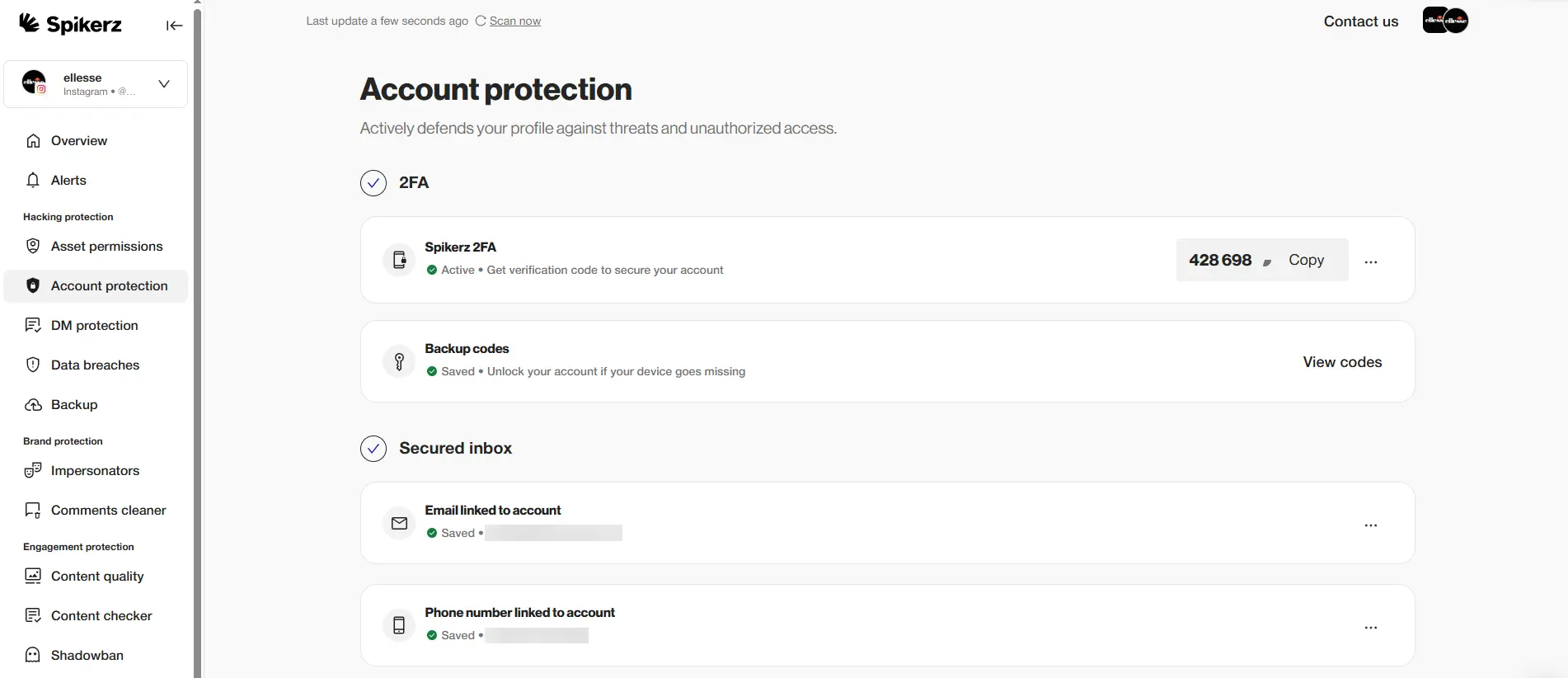
Spikerz is a social media security platform built to eliminate the exact workflow risks that leave high-profile accounts open to attack. It connects through official APIs in three clicks, with zero password sharing required.
Here's how Spikerz helps you protect your brand:
- Unified, passwordless access control: Eliminate the "who has the password?" vulnerability. Spikerz routes access through a single secure platform, so credentials are never exposed, shared, or held for ransom by a former employee.
- Enterprise 2FA-as-a-Service: Stop linking your business's security to one employee's personal device. Spikerz hosts and manages 2FA tokens through a secure web-based dashboard for your whole team, cutting out risky text-forwarding and Slack messages.
- Active access monitoring and whitelisting: Native platform alerts tell you you've been hacked after the fact. Spikerz tracks suspicious login behavior, location anomalies, and risky devices in real time, so you can stop an attack mid-attempt.
- Instant emergency lockouts and secure recovery: When a crypto scammer tries to force entry, you don't have to wait days for X's support team while your reputation burns. Spikerz lets you instantly revoke access or rotate credentials, and auto-forwards recovery messages safely to the whole team so nothing slips through the cracks.
Why hand crypto scammers the keys to a brand you spent years building?
Book a demo with Spikerz today and lock down your accounts before the next wave of attacks reaches you.
Conclusion
This recent hack is a reminder that no institution, no follower count, and no level of professional credibility makes you immune to crypto scammers and account takeovers. Hackers don't care who you are; they care about which doors you left unlocked.
But you can prevent this from happening to you. The fix starts with discipline: authenticator apps, audited integrations, and a documented crisis plan. But discipline alone won't scale with a marketing team that needs to move fast, post often, and share access without sharing passwords. That’s where most brands get hit hardest.
The good news is, Spikerz closes that gap. With Spikerz you get unified access control, enterprise-grade 2FA, real-time monitoring, and instant lockout capabilities, that allow you to stop treating social media security as an afterthought and start treating it as the brand-protection function it should have always been.
Your audience trusts you. Make sure the next message they see actually comes from you.
