Social media access management: control who's in


Social media access management is how you control who can log in to your brand's accounts and what they can do there. Shared passwords, former employees, too many admins and forgotten apps all leave a way in for attackers, and the IAM tools IT teams use can't see inside social platforms. Learn how roles work on Meta and LinkedIn, how to apply least privilege, and six steps to get access under control and keep it that way.
Ask most marketing teams who has access to their brand's Instagram account and you'll get a pause, then a guess. The social media manager, probably the agency, maybe the freelancer from last year's launch. Nobody's quite sure, and nobody has a list.
That uncertainty is the problem. Every person, agency and app with access to your accounts is a way in for an attacker, and the ones you've forgotten about are the ones nobody's watching.
This guide explains what social media access management is, why the identity tools your IT team already uses don't cover it, how roles work on Meta and LinkedIn, and six steps to get access under control.
What is social media access management?
Social media access management is the process of controlling who can log in to your brand's social accounts and what they can do once they're in. It covers giving people the right access when they join, changing it when their role changes and removing it the day they leave.
It's a specialized form of identity and access management (IAM), the discipline IT teams use to control access to email, cloud apps and internal systems. The difference is that social platforms run their own login and permission systems, which most IAM tools can't see inside.
What is user access management (UAM)?
User access management (UAM) is the part of IAM that decides which users can reach which resources, based on their role. Each role comes with a set of permissions, so access follows the job a person does instead of being granted one account at a time. UAM has four parts:
- Authentication: checking that users are who they say they are, usually with a password and a second factor.
- Authorization: deciding what each authenticated user is allowed to do.
- Provisioning: creating, changing and removing user access as people join, move and leave.
- Access control: the settings that enforce those decisions, like roles and permission levels.
On social media, all four usually happen by hand, platform by platform, which is why access drifts so easily.
Why social media access gets out of control
Access rarely gets out of control on purpose. It builds up quietly, one shortcut at a time.
Shared passwords
When a team shares one login, the password ends up in text messages, notes apps and Slack threads. You can't tell who posted what, and you can't remove one person without changing the password for everyone. Our guide to password sharing for teams covers safer options.
Former employees and agencies
IT usually removes a departing employee's email access within hours. Their access to your Instagram account, your Facebook Page or your ad account often stays for weeks or months, because nobody owns that job. The same goes for agencies and freelancers once a contract ends.
Too many admins
Full admin rights are the easiest thing to give, so they get given to everyone. Someone who only needs to schedule posts ends up able to remove other admins, change the recovery email or delete the account.
Connected apps nobody remembers
Scheduling, analytics and listening tools keep their access until someone removes them. If one of those apps is breached, the attacker can reach your account without ever knowing your password.
Each of these gaps gives attackers an easy way in. Account takeover is a growing problem: the FBI received more than 5,100 account takeover fraud complaints in 2025, with losses over $262 million.1 Our account takeover prevention guide explains how attackers use these gaps.
Why traditional IAM tools don't cover social media
Most IAM and single sign-on tools were built for systems a company owns or licenses, like email, a CRM or cloud storage. Social platforms are different in three ways.
- They have their own permission systems. Instagram, Facebook, LinkedIn, TikTok, YouTube and X each decide who can post, reply, run ads and manage settings. An IAM tool can control who reaches the login page, but not the role someone holds inside the platform.
- They can't see activity. An IAM tool can show that someone logged in. It can't show who published a post, changed a bio or added a new admin.
- Every platform works differently. A team running a dozen accounts across six platforms is dealing with six sets of roles, rules and security settings, and no single place to see them.
That's why so many teams fall back on shared passwords, even when the rest of the company has strong identity controls.
Why connecting through official APIs is safer

When a tool connects to a platform through its official API, the platform gives the tool an access token instead of your password. The token only allows what you approved, and you can revoke it at any time without changing your password. That's a much safer way to give tools access than typing your login into them.
Apply Zero Trust and least privilege to your social accounts
Zero trust is a security approach built on one rule: never trust, always verify. Nobody gets access by default, and every request is checked, wherever it comes from.
Least privilege is how you put that into practice. It means each person gets only the access their work requires, and nothing more.2 On social media, that looks like this:
- A content creator can draft and publish posts, but can't add or remove admins.
- A community manager can reply to comments and messages, but can't change account settings.
- An analyst can see insights, but can't post anything.
- An agency gets access to the accounts it works on, for as long as the contract runs.
Least privilege limits the damage if any one person's account is compromised, whether by a phishing email or an insider with a grudge.
How access roles work on each platform
Every platform has its own roles, so it helps to know what you're working with.
Facebook and Instagram
Meta manages access through business portfolios in Meta Business Suite. People get either full control of the portfolio or partial access, and you then decide which Pages, Instagram accounts and ad accounts each person can work on and what they can do there.
Give full control to as few people as possible, ideally two trusted employees, so you're never locked out if one leaves. For step-by-step help, see how to manage Facebook Page admins, how to remove someone from Meta Business Suite and our Facebook Page roles audit.
LinkedIn Pages have admin roles for managing the Page, including super admin, content admin, analyst and curator, plus separate roles for running paid campaigns. Only super admins can manage other admins, so keep that role to the smallest group you can. LinkedIn's help center explains what each Page admin role can do.
TikTok, YouTube and X
TikTok, YouTube and X each have their own ways to add team members, and each changes them from time to time. The principle is the same everywhere: give each person their own access instead of a shared login, and give them the lowest role that lets them do their job.
How to set up social media access management in 6 steps
Work through these steps in order. The first two give you a clear picture, and the rest keep it that way.
1. List every account and everyone with access
Start with an inventory of every social and ad account tied to your brand, including regional pages, executive profiles and accounts you've stopped posting on. Then list every person, agency and connected app with access to each one, and the role they hold.
2. Cut access back to what each person needs
Compare the list against your current team. Remove anyone who has left, lower any role that's higher than the job requires and disconnect apps you no longer use.
3. Stop sharing passwords
Give each person their own access through the platform's role system, or through a tool that connects via official APIs. When nobody holds the password, nobody can leak it.
4. Take 2FA off personal phones
Two-factor authentication tied to one employee's phone locks everyone else out when they're away, and puts the account at risk if their phone is compromised. 2FA for teams keeps codes in one secure place that the right people can reach.
5. Build access into onboarding and offboarding
Add social accounts to your joiner and leaver checklists so access is granted on day one and removed on the last day. Make one person responsible for it, and do the same when an agency or freelancer contract ends.
6. Review access regularly and watch for changes
Review every account's access at least once a quarter, and monthly if your team or agencies change often. Between reviews, set up alerts for new admins, role changes and logins from unfamiliar locations, so you hear about them the day they happen.
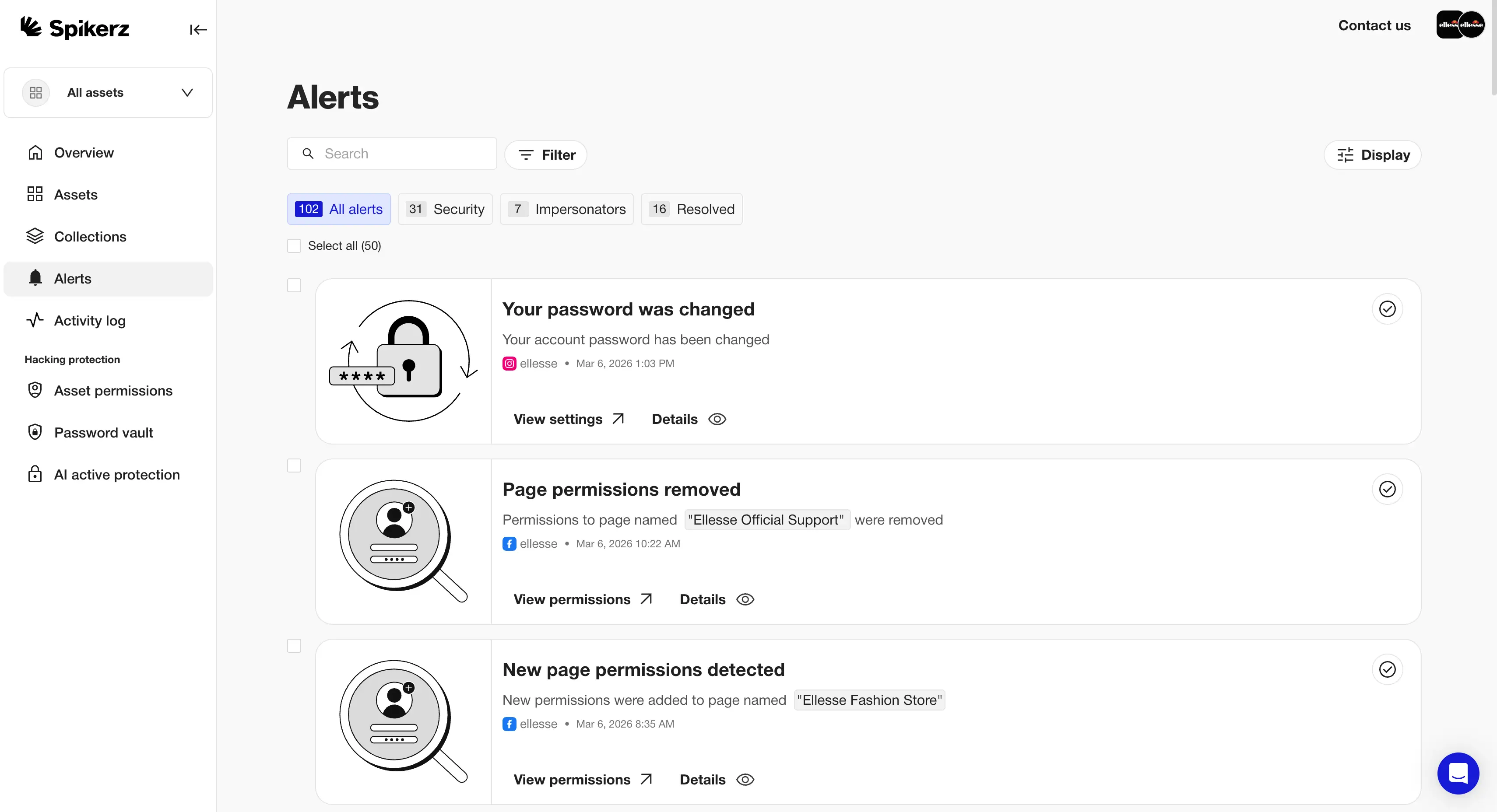
How Spikerz helps you manage social media access
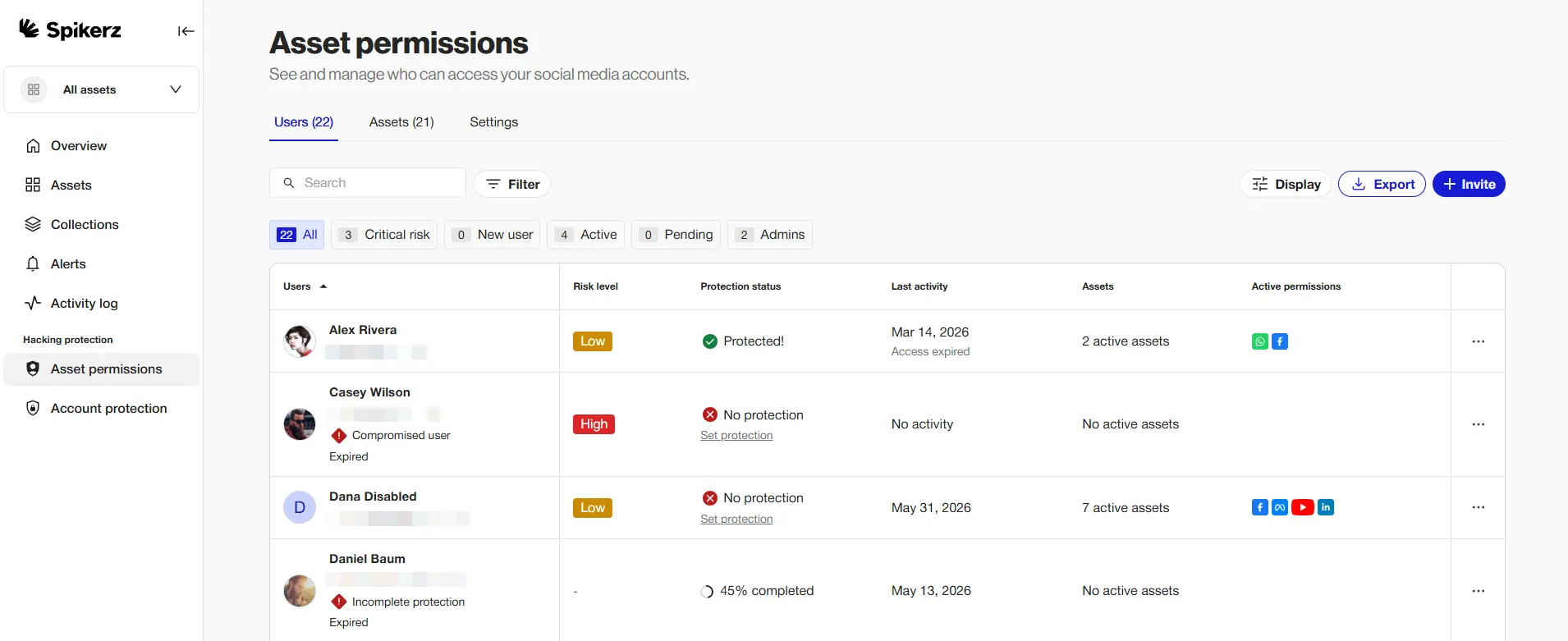
Spikerz is a social media security platform that connects through official platform APIs, so you never share your passwords with us. It gives marketing and security teams one view of who can reach every account, and stops access from drifting.
- Access management: see every person and app with access to every account across platforms in one dashboard, and remove access when someone leaves.
- Permission alerts: get notified when someone adds an admin, removes a role or changes permissions on your accounts.
- 2FA for teams: keep 2FA codes in one secure place instead of on personal phones.
- Account takeover protection: spot suspicious logins, log intruders out and rotate the password automatically.
- Phishing protection: catch phishing in emails, DMs and comments before it reaches the people who hold access.
Want to know exactly who has access to your brand's accounts? Book a consultation and we'll show you how Spikerz works.
Conclusion
Social media access management comes down to knowing who can reach your accounts, giving each person only what they need and taking access away the moment it's no longer needed. Generic IAM tools can't do that inside social platforms, so it falls to the team that runs them.
Start with the inventory, cut access back, stop sharing passwords and build access into onboarding and offboarding. Then review it regularly so it stays clean.
Book a consultation to see how Spikerz keeps access to your brand's accounts under control.
Sources
- FBI Internet Crime Complaint Center, "Account takeover fraud via impersonation of financial institution support", public service announcement I-112525-PSA, November 25, 2025. ic3.gov/PSA/2025/PSA251125
- National Institute of Standards and Technology, "Least privilege", Computer Security Resource Center glossary. csrc.nist.gov/glossary/term/least_privilege