No business is too big to get hacked. Here’s why


Hackers hijacked a major gaming brand’s X account to promote a fake 30th-anniversary memecoin. Here’s how the scam worked, why no business is too big to be targeted, and eight steps to protect your accounts from a takeover.
The biggest, most recognizable brands in the world are watching their social media accounts get hijacked to run crypto scams. It doesn't matter how large the company is or how many followers it has. If an account has reach, attackers want it.
A major gaming company proved that point. This is a 30-year-old brand with one of the most-followed accounts in all of gaming, backed by decades of trust from fans around the world. And it still got hit.
So here's the hard truth: if it can happen to a gaming giant, it can happen to your business.
In this blog post, we'll break down what happened to this gaming company's X account, why you should care, and the exact steps you can take right now to protect your own accounts from a takeover.
What happened to this gaming company's X account?
On August 27, 2026, the official X account of a major gaming company was hijacked and used to run a cryptocurrency scam. Here's what we know:
The company's official account on X was temporarily compromised and used to promote a fraudulent memecoin, named after the brand and disguised as a 30th-anniversary celebration.
The scam post invited fans to "celebrate 30 years" of the franchise "in a whole new way" by buying what it called the brand's "official memecoin," and to join fans around the world in the anniversary celebration.
The post included a crypto contract address and a link to a page built to look like a legitimate 30th-anniversary site, tricking fans into connecting their wallets and buying a worthless token.
The post was live for around 30 minutes before it was taken down. Most followers weren't fooled, and community notes started appearing under the scam almost immediately.
Soon after the company published a statement addressing the hack: "We're aware that our X account was accessed without authorization and used to publish posts promoting a cryptocurrency. Those posts were not created or approved by [the company] and have been removed. We have secured the account and are investigating the incident. We're sorry for the confusion and appreciate your patience."
This isn't the first time the brand has been digitally infiltrated. In late 2024, hackers pulled off one of the largest leaks in the franchise's history after a development partner's servers were breached, spilling hundreds of gigabytes of internal data. In 2025, hackers released files from an upcoming game showing cut content and early builds.
Why should you pay attention to this hack?
This company recovered quickly, but most brands aren't that lucky. A hijacked account can scam your customers and burn years of trust in minutes, all while you scramble to regain control. And this trend isn't slowing down, the data makes that very clear:
- Attackers target high-profile accounts because they let hackers tap into a massive, trusting audience with very little effort. A single scam post from a verified brand account can reach millions before anyone catches it.
- According to Cybersecurity Ventures, global cybercrime costs are expected to grow by 15% per year, reaching $10.5 trillion USD globally this year and $12 trillion annually by 2031.
- That said, attackers aren't always using malware to break in. According to CrowdStrike's 2025 Global Threat Report, malware-free activity accounted for 79% of detections in 2024, a sharp rise from 40% in 2019. In other words, social engineering and phishing do most of the work now.
- According to KnowBe4's 2025 Phishing Threat Trends Report, phishing emails rose 17.3% in a six-month span, and 57.9% of phishing emails were sent from already-compromised accounts.
This is something every business has to keep in mind. But that doesn't mean there's nothing you can do about it.
How to protect your X account from hacks
The company didn't share how attackers got in. But hijacks like this usually come down to having weak credentials, phishing, a stolen session, or social engineering. The good news is that you can reduce your attack surface and make your account far harder to breach.
Here's what we recommend you do right now:
1) Use strong passwords across all accounts
Your password strength is one of the easiest ways attackers measure how hard your account will be to breach. That's why, as your first layer of defense, you should make it as strong as possible and never reuse it across platforms.
A strong password is long, random, and unpredictable. Aim for at least 16 characters (the longer the better), and mix uppercase letters, lowercase letters, numbers, and special symbols so it can't be guessed or brute-forced. For example: @MB%Wpt?U5fBJ.M$UFW!
Also, if you're worried about remembering them all, use a password manager to securely create, store, and retrieve them. A few good options include Proton Pass, 1Password, LastPass, and Bitdefender SecurePass.
2) Use authenticator apps for 2FA
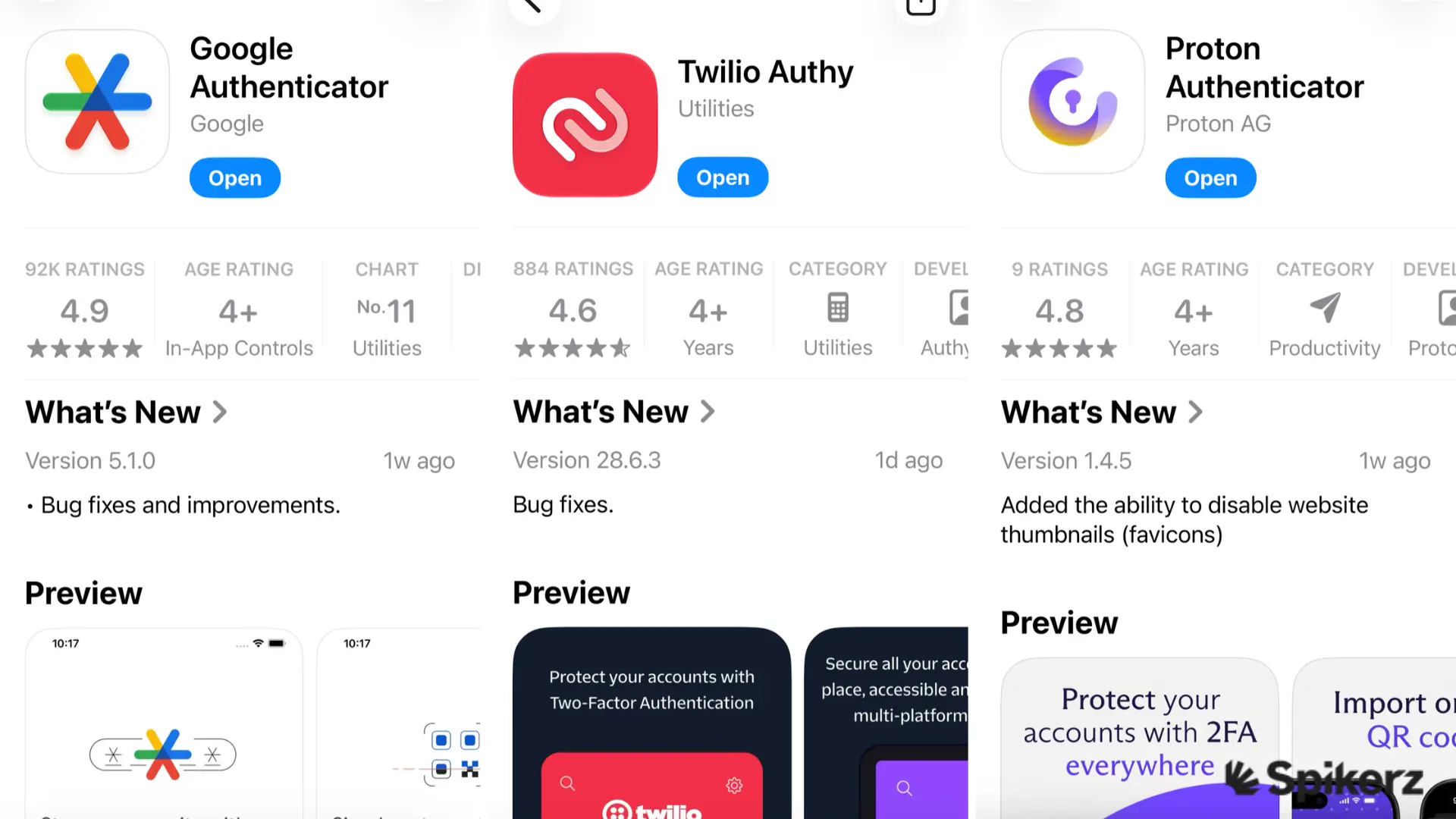
Two-factor authentication (2FA) adds a second layer of security to your account, requiring a time-sensitive code besides your password. But you should never use SMS for 2FA. Phone numbers can be hijacked through SIM swap attacks, where an attacker convinces your carrier to move your number to their device and intercepts your codes. They can also be stolen with malware like infostealers.
Instead, always use an authenticator app on a separate device. Keeping your codes on a dedicated device reduces the chance of them being leaked or stolen.
3) Enable 2FA for teams
Authenticator apps are a fantastic option for most people, but they get messy for businesses. Multiple people often need access to the same account, and sharing a single code quickly becomes a security nightmare.
The good news is that team-based 2FA changes everything. For example, at Spikerz, we host and manage 2FA tokens through a secure web-based dashboard for your whole team, so nobody has to share codes over Slack or WhatsApp.
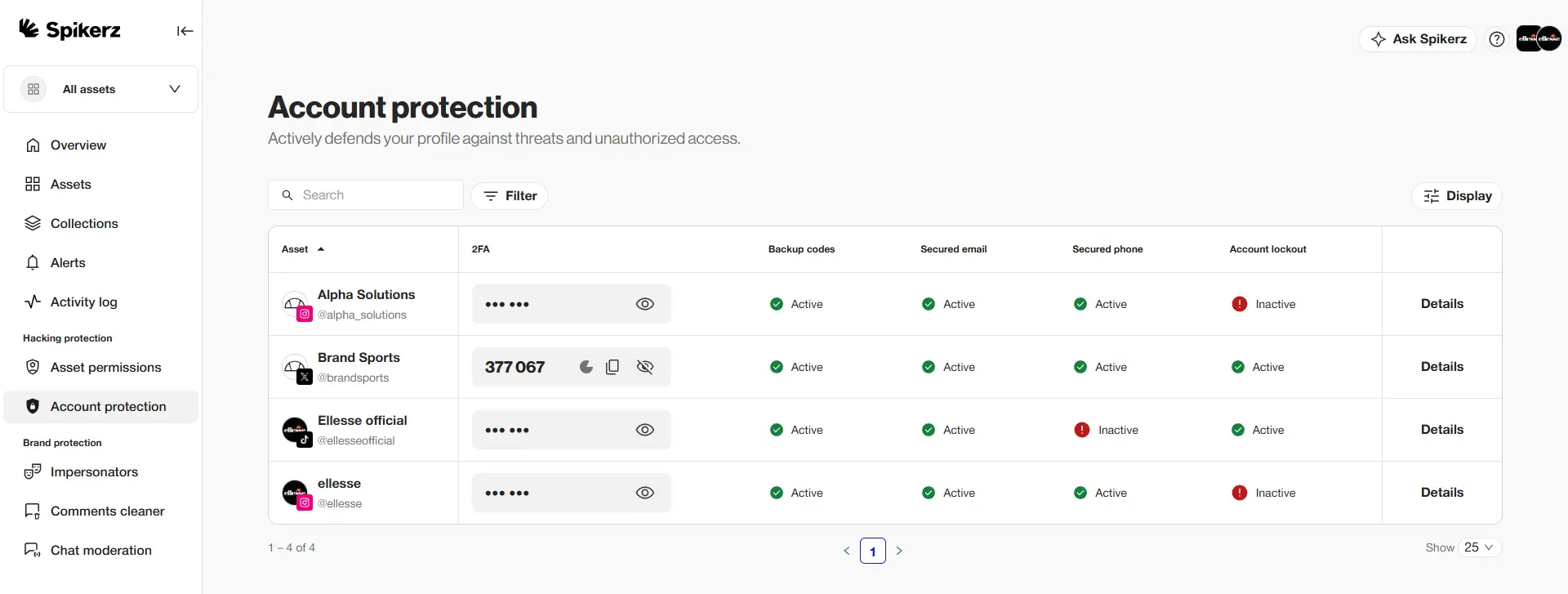
That kind of habit is exactly what creates major security risks. One code in a group chat is all it takes to hand over your account to the wrong person.
4) Regularly review and revoke account access
It's extremely important to regularly review who has access to your accounts. People naturally leave organizations, and sometimes they keep admin rights they no longer need.
If one of those forgotten accounts gets hacked, you can lose your own account through them. That's why you should revoke access the moment someone no longer needs it.
Unfortunately, this is something we've seen cause a lot of preventable damage. A former contractor's forgotten login can hand an attacker full control of your account. And in some cases, that past contractor can access your account to do damage on their own.
5) Protect your local devices with antivirus software
While 2FA and monitoring stop most threats, they aren't perfect. Some attacks let hackers bypass your password and 2FA altogether by stealing your active session.
These are called session hijacking attacks. Infostealers grab the session cookies stored on your device and use them to log in as you.
The best way to stop them is traditional antivirus software, which scans your device for malicious programs and removes them before they can steal your data. If you want a recommendation, we recommend Bitdefender as one of the best options available.
6) Enable account monitoring
Social media account monitoring watches your accounts around the clock for suspicious activity, like a login from an unfamiliar location or device, and alerts you the moment something seems wrong. There are many tools on the market, but you should choose one that focuses on security, like Spikerz.
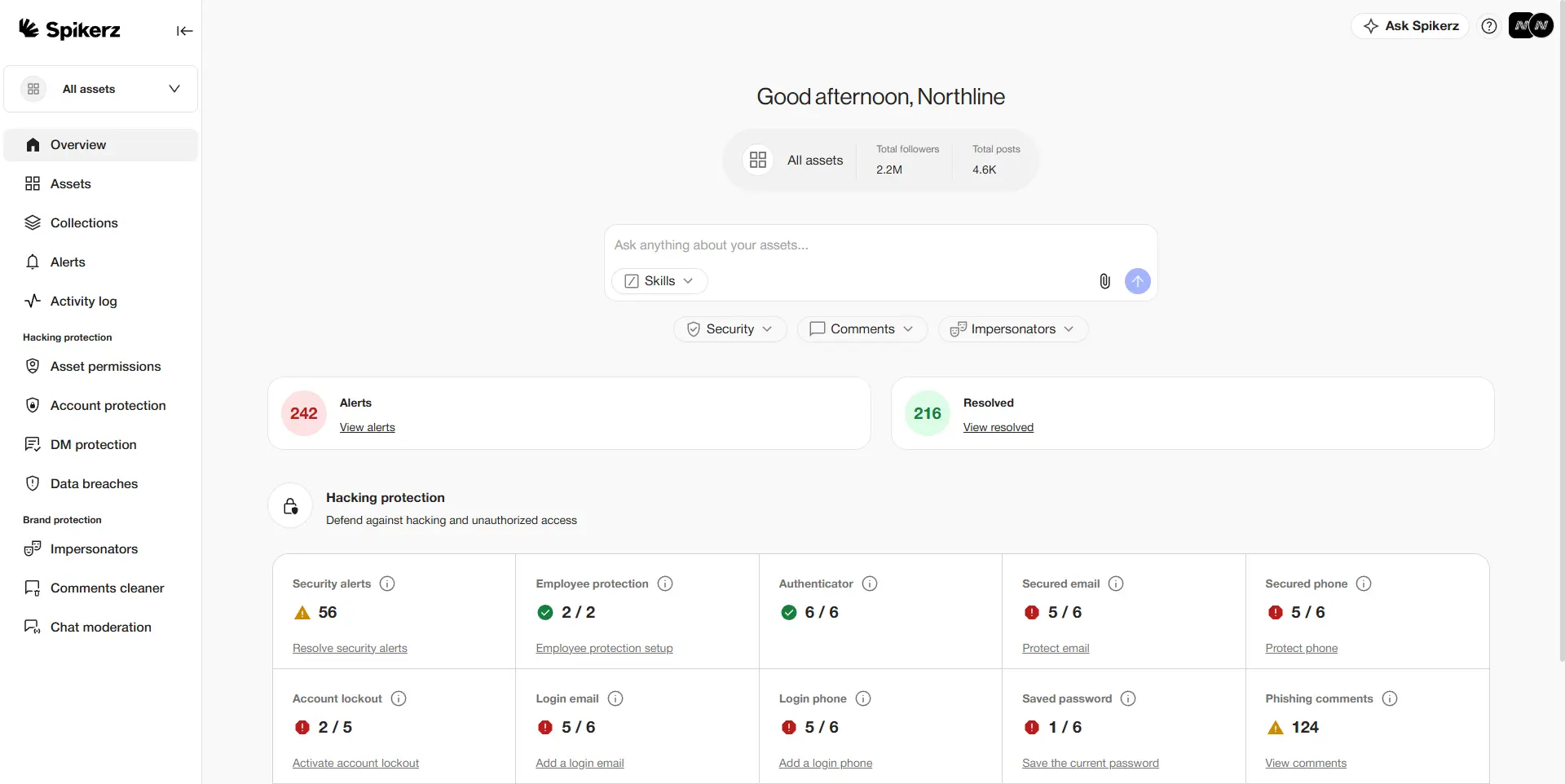
Spikerz is an all-in-one social media security platform that helps brands protect their social media presence. We connect through official APIs in just a few clicks, so you're protected without ever handing over your passwords. Here's what we do:
- Account takeover protection: blocks unauthorized access and hijacking attempts in real time.
- Phishing protection: scans incoming DMs and links, neutralizing threats before anyone clicks.
- Permissions management: gives you full visibility and control over who can access your accounts.
- Impersonator takedown: finds and removes fake accounts impersonating your brand.
- Comment moderation: automatically hides scams, spam, and hate speech across your posts.
So ask yourself: how much is your audience's trust worth, and what would it cost you to lose it in 30 minutes?
If you truly want to protect your social media accounts, book a consultation right now. We'll show you how we can secure your social media presence.
7) Create a social media policy
A social media policy is a clear set of rules that decides who gets access to your accounts, what they're allowed to publish, and how they should use them. If you want to create one in minutes, check our customizable template. It covers a customized policy based on your teams, accounts, and risks, a review of your current security blind spots, and a workflow for approval, access, and crisis response.
8) Build a rapid response team (RRT)
Even with strong defenses, no account is fully hackproof, so you should always prepare for the worst. A rapid response team is a small group across your social media and security teams that's ready to identify a breach and respond before the damage spreads.
Look at this gaming company's hack as an example. Since the account was monitored and recovered within about 30 minutes, the scam did limited damage. Now contrast that with brands that take days or weeks to regain control. By the time they do, the scam has already reached their audience, drained trust, and left a mark many never fully recover from.
Conclusion
The simple truth is that attackers go where the audience is. A verified account with millions of followers is one of the most valuable things a hacker can hold, even for 30 minutes.
In this case, the post came down within about 30 minutes, which limited the damage. The account was monitored, the breach was caught, and access was re-secured before the scam could spread. That same outcome is within reach for any business willing to reduce its attack surface ahead of time, through strong passwords, team-based 2FA, tight access control, and around-the-clock monitoring.