Social media threat monitoring for executives

.webp)
Executives are prime targets for fake profiles, hijacked accounts, deepfakes and phishing messages sent in their name. This guide covers the main threats and seven ways to build an executive social media monitoring program.
Social media threat monitoring for executives is the continuous watch for fake profiles, hijacked accounts, phishing messages and exposed personal details that target a company's leaders. Executives are targeted because their names carry authority and trust, so one convincing fake or stolen account can be used to scam employees, customers and investors. This guide explains the main threats, from executive impersonation to deepfakes, and seven ways to build a monitoring program.
For a broader view of how Spikerz approaches protecting executives and employees on social media, see our employee protection page.
Why trust Spikerz on this topic?
At Spikerz, we specialize in protecting social media accounts from cyber threats, helping brands and high-profile individuals prevent account takeovers, impersonation, and other attacks. Trusted by leading global brands like Powtoon and Astra Nova, we've seen firsthand how executive social media threats unfold, and that experience shapes the recommendations in this guide.
Why are executives high-risk targets on social media?
Attackers go after executives because a single compromised leader is the most efficient way into an organization.
Executive accounts hold unique influence
An executive account functions like a master key. Senior leaders have authority, access to sensitive information, and trusted relationships with employees, customers, partners, and investors. If attackers gain control of an executive profile or successfully impersonate one, they can use that credibility to launch phishing campaigns, spread misinformation, request payments, or manipulate internal teams.

Visibility creates opportunity
Social media has become a primary channel for customer engagement, making executive profiles more visible and influential than ever. The same visibility also makes executives easier to impersonate. Public posts, interviews, company biographies, and professional updates provide attackers with a steady stream of information that can be used to create convincing fake profiles and highly personalized scams.
The executive protection gap
Many organizations also face an ownership gap. Marketing teams manage executive social presence, security teams manage cyber risk, and neither team fully owns executive protection. As a result, impersonation attempts and social media threats often remain undetected until reputational or financial damage has already occurred.
What social media threats target executives?
Hijacked executive accounts
Hackers use phishing emails, credential theft, SIM swapping, and compromised personal accounts to gain access to executive social profiles. Once inside, they can publish fraudulent posts, send malicious messages, or damage brand credibility within minutes.
Executive impersonation and fake profiles
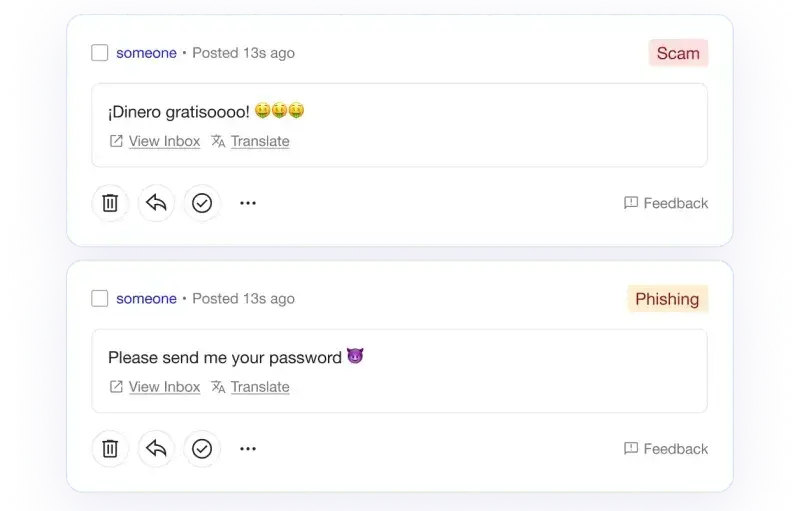
Fake profiles that copy CEOs, founders and senior leaders are often used to scam customers, investors, employees and partners. They reuse real photos, bios and writing style, so they can fool followers long before anyone reports them. A related case is Airbnb CEO Brian Chesky's X account being compromised, where attackers used his trusted profile to publish posts that appeared to come from him.
Phishing DMs that use an executive's name
Attackers don't always need a convincing profile. A message that simply says "this is the CEO, I need a quick favor" can push an employee to share data, buy gift cards or click a link. These social media phishing messages work best when they reference real projects or colleagues pulled from public posts.
Exposure of personal details
Executives are increasingly vulnerable to the public exposure of personal information, including home addresses, phone numbers, family details and compensation data. Attackers often assemble this from many public sources rather than a single breach, then use it to make impersonation and phishing more believable.
Deepfake voice and video
AI tools now let attackers clone an executive's voice or face from a few public clips. Deepfakes can be used to spread misinformation, push fraudulent payment requests, manipulate investors or damage a leader's reputation before the content is proven false. In May 2025, the FBI warned that attackers were using AI-generated voice messages to impersonate senior government officials and contact their associates. See our guide to deepfake defense for more.
7 ways to build an executive threat monitoring program
1. Harden account fundamentals
Most executive account takeovers happen because attackers exploit overlooked recovery paths and weak links in the authentication chain, not because they crack a password.
For example, the SEC's X account compromise in 2024 happened in part because multi-factor authentication (MFA) wasn't enabled on the account. While SMS-based MFA offers some protection, it is still vulnerable to SIM-swapping attacks. App-based authenticators or hardware security keys provide a much stronger defense.
Password reuse remains another common point of entry. When credentials are exposed in one data breach, attackers immediately test them across other platforms. Using a password manager makes it much easier to maintain unique, complex passwords for every social account.
Teams should also review the entire account recovery chain at least once every quarter, paying close attention to:
- Recovery email addresses and phone numbers, which can be compromised independently and used to regain access to executive accounts.
- Inactive sessions on devices that are no longer in use, as well as sessions left behind by former employees, agencies, or contractors.
- Connected third-party applications with posting or administrative permissions that no longer serve a business purpose but still have access to the account.
2. Defend against session hijacking
Session hijacking is an effective way to compromise accounts because it can bypass multi-factor authentication (MFA). Instead of stealing passwords, attackers use infostealer malware to extract session cookies from an executive's device, allowing them to access accounts without triggering a new login or authentication challenge.
Organizations can reduce this risk by focusing on a few key areas:
- Deploy endpoint protection that detects infostealer malware on every device executives use to access social media. These threats are commonly delivered through fake software updates, malicious email attachments, or unauthorized applications.
- Keep browsers and operating systems fully updated. Security patches regularly fix vulnerabilities that infostealer malware and browser-based exploits rely on. Add Spikerz to monitor executive social accounts for suspicious logins and unusual security changes that could mean an attacker is already inside.

- Require re-authentication for sensitive account changes, including password resets, recovery option updates, and security setting changes.
- Train executives to recognize infostealer tactics, especially fake downloads, phishing emails, and other social engineering techniques designed to steal authenticated sessions.
3. Set up continuous impersonation monitoring
One industry analysis found that in Q3 2025, accounts impersonating senior executives made up more than 54% of all impersonation activity.
Even so, many organizations only discover executive impersonation after someone else spots it. An employee receives a suspicious message, a customer reports a fake profile, or a business partner notices something unusual. By that point, the impersonator may have already contacted dozens of potential victims.
An effective impersonation monitoring program should include:
- Lookalike profile detection to identify accounts using variations of an executive's name, username, company affiliation, or bio to appear legitimate.
- Coordinated campaign detection to identify networks of fake profiles that interact with one another to appear legitimate.
- Monitoring executive mentions and suspicious activity, such as spikes in tagged posts, comments containing phishing links, or accounts attempting to direct followers to external websites.
When a fake account is identified, speed is critical. Every hour it stays active raises the risk of phishing, financial fraud and reputational damage, and manual checks are too slow to keep up.
Spikerz continuously scans major social platforms for executive impersonators using AI detection. Once it finds a fake account, it helps you submit takedowns through platform integrations, so your team isn't chasing reports by hand.

4. Secure the extended attack surface
Executive security extends beyond the executive's own social media accounts. Even leaders who follow strong security practices can be exposed through family members, close contacts, or publicly available personal information.
A real-world example comes from Sweden, where bodyguards protecting members of the royal family and the Prime Minister unknowingly revealed private addresses and movement patterns by uploading workout routes to the fitness app Strava. It showed how seemingly harmless activity by people around high-profile individuals can expose sensitive information that attackers can exploit.
Personal information is also widely available through data broker websites, allowing attackers to piece together travel patterns, relationships, and other details that make phishing and impersonation attempts far more convincing.
To reduce this exposure, organizations should:
- Educate executives and their families about the risks of sharing personal information online. The goal is to build awareness of what is posted, tagged, or made publicly visible rather than discourage social media use.
- Encourage family members to use private accounts whenever possible to reduce the amount of information available to attackers.
- Regularly remove personal information from data broker sites, as these databases are continuously updated and often republish removed records.
- Keep personal and professional social media accounts separate, with executive-facing business accounts managed under formal security and governance policies.
5. Put governance and access controls in place
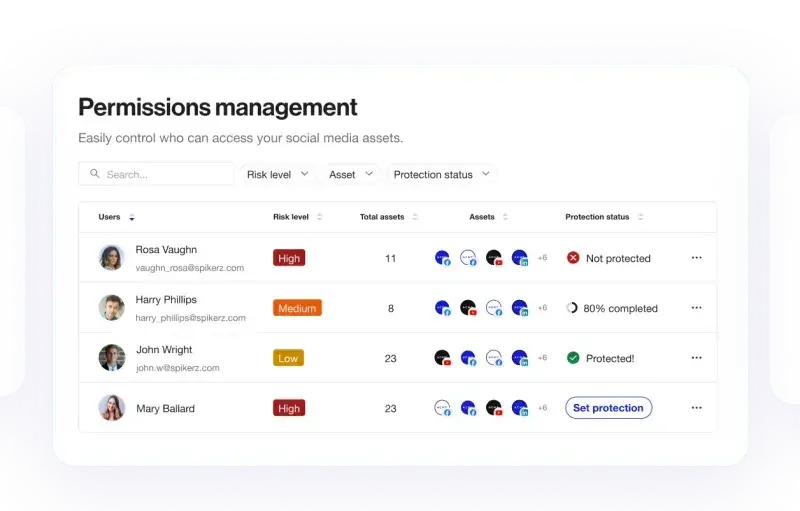
One of the biggest security risks is not knowing who has access to executive social media accounts. Over time, permissions accumulate as employees change roles, agencies come and go, and contractors are brought in for short-term projects. Without regular oversight, former users may retain access long after they should have been removed.
A strong governance program should include:
- A complete inventory of everyone with admin access to each executive account.
- Automated access revocation whenever an employee leaves or an agency engagement ends, reducing the delays that come with manual offboarding.
- Approval workflows and audit trails for every new permission granted, so access changes are documented and easy to review.
- Quarterly access reviews to remove outdated or unnecessary permissions before they become a security issue.
This is exactly the challenge Spikerz helps organizations solve. Brands such as Speedo and Ellesse used the platform to gain complete visibility into who could access their social accounts, making it far easier to manage permissions and quickly revoke access when team members or agency relationships changed.
6. Build a rapid incident response capability
No organization can prevent every executive social media incident. What separates a minor disruption from a major reputational crisis is how quickly the response begins. Having a documented incident response plan ensures teams know exactly what to do instead of making decisions under pressure.
In the first 15 minutes, confirm whether the account has actually been compromised by checking for unauthorized posts, profile changes, or unusual login activity. Capture screenshots of any suspicious content before it is removed, as these records may be needed for internal investigations, legal action, or communication with the social platform. You should also verify whether you still control the account's recovery email, phone number, and password.
During the first hour, focus on containing the incident. Attempt to regain access using the platform's recovery tools, revoke third-party app permissions, and report the compromise through the platform's official support channels. At the same time, notify internal stakeholders, including security, marketing, legal, communications, and executive leadership.
Within the first 24 hours, prepare a clear public statement if needed, avoiding speculation about the cause until the facts are confirmed. If customers, employees, or partners may have received phishing messages from the compromised account, notify them as soon as possible and continue monitoring for follow-on attacks targeting the executive's network.
Once the incident is resolved, conduct a post-incident review to identify how the compromise occurred, whether through phishing, session hijacking, credential theft, or another method. Use those findings to strengthen security controls, update the incident response plan, and determine whether any regulatory or reporting obligations apply.
7. Bridge the organizational gap
Executive social media security often falls into a gray area. Marketing teams manage executive accounts, security teams focus on cyber threats, and legal and communications become involved only after an incident occurs.
To close this gap, organizations should clearly define who is responsible for monitoring, prevention, and incident response. While these responsibilities may be shared across teams, each one should have a designated owner and a documented escalation process.
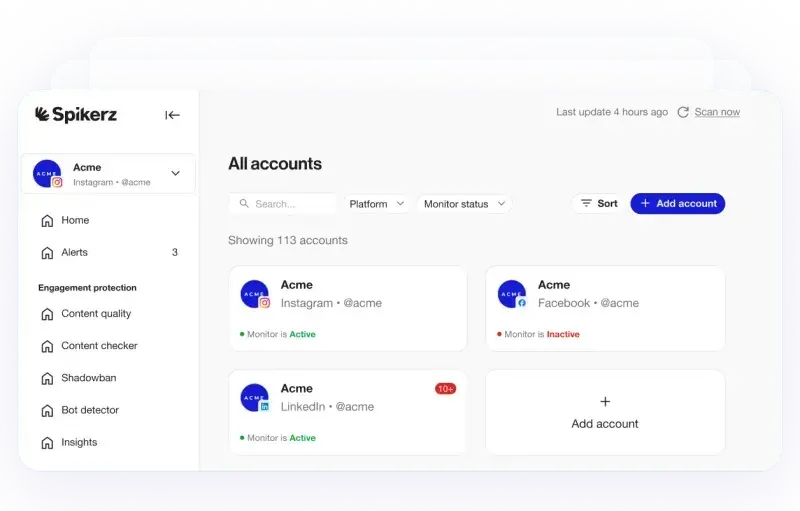
It's also important to establish a cross-functional team that includes marketing, security, legal, and communications. Platforms like Spikerz help support this model by giving both marketing and security teams a shared view of executive social media risk without creating separate workflows.
Finally, make executive social media security part of every new leader's onboarding. Cover topics such as impersonation risks, verified accounts, reporting procedures, and security best practices from day one. Combined with regular tabletop exercises that simulate real incidents, these steps help ensure everyone knows their role before an attack occurs.
Strengthen executive social media protection with Spikerz
Executive social media threats aren't slowing down. As impersonation, account takeovers and AI-generated scams get more sophisticated, organizations need to move from reactive cleanup to continuous monitoring of the people attackers target most.
Spikerz monitors for impersonation, suspicious account activity and access risks, giving security and marketing teams the visibility to respond faster. Learn more about protecting executives and employees, or book a consultation to see it in action. For the wider picture, read our guide to digital risk protection.


