Online brand protection in 2026: Guide for consumer brands

Online brand protection covers five surfaces: social media, domains, marketplaces, app stores and paid ads. This guide explains why social is the biggest and least-defended one, what strong coverage looks like, and how to build a brand protection strategy for 2026.
According to the FTC’s Data Spotlight, in 2025, people reported losing $2.1 billion to scams that started on social media (about eight times what they lost in 2020). Most of those scams used a brand's name, logo, or face.
That’s why online brand protection is no longer only about trademarks and fake websites. It’s about defending your brand everywhere your customers can be reached.
But many brands still mainly focus most of their protection on traditional attack surfaces, like domains and marketplaces, while their social accounts sit wide open.
In this guide we cover what online brand protection is, the five surfaces it covers, why social is the biggest and least-defended one, what strong coverage looks like, and how to build a strategy.
What is online brand protection?
Online brand protection is the practice of finding and stopping all the ways criminals misuse your brand across the internet, including fake social accounts, spoofed websites, counterfeit listings, fake apps, and scam ads. Its goal is to protect your brand's trust and the revenue that trust generates.
That said, this standard definition treats online brand protection as a mix of monitoring, detection, and takedown. However, what it really protects is trust. When a stranger uses your name to run a scam, your customers pay for it, and they blame you.
That’s why online brand protection is not one job, it’s five. Your brand shows up on five different surfaces online, and each one gets attacked in its own way.
The five surfaces online brand protection covers
Your brand likely lives in five areas online. Criminals know this so they attack each one differently. Many protection tools cover the first two well but offer much less coverage for the rest, so keep that in mind when choosing one. Here is each surface, the threat it faces, and how attacks play out:
- Social media gets abused through fake accounts, scam comments, and takeover attempts. Criminals can impersonate your brand, lure followers into scams, or gain control of your real account.
- Domains and websites get attacked through spoofed domains. Criminals use them to create phishing pages or fake stores that look like your brand.
- Online marketplaces draw counterfeiters and unauthorized sellers who list fake versions of your products and use your brand name to make them look legitimate.
- App stores attract fake apps that copy your name and icon. Criminals use them to trick people into downloading malware or handing over their logins.
- Paid ads get abused through fraudulent search and social ads. Criminals use your brand name to send people to phishing sites, fake stores, or other scam pages.
Threat surface summary
Why social media is the biggest, least-defended surface
If you only have the budget for one area in 2026, data says you should spend it defending your social media. It’s where much of a brand's money is lost, and it’s also where impersonation is climbing fastest, yet it’s the surface most brand protection tools cover the least.
Keep this in mind:
- According to the FTC’s Data Spotlight, in 2025, nearly 30% of people who reported losing money to a scam said it started on social media, with reported losses of $2.1 billion (about eight times the 2020 total).
- Also, according to the same FTC source, people reported more money lost to scams that started on Facebook than on any other platform, with WhatsApp and Instagram next.
- According to Check Point's Q2 2026 Brand Phishing Report, social networks were the second most impersonated category after technology, and LinkedIn ranked in the top five most impersonated brands.
That said, let’s take a look at why this is the case.
Your audience trusts your social media profiles
Social media works well for cybercriminals because your followers already trust you, all they have to do is borrow that credibility. Think of it this way: A phishing email from a stranger is easy to ignore, but a DM from what looks like your brand is not.
Most monitoring tools were built for other platforms
Most brand protection platforms grew up defending domains, trademarks, and marketplaces, so social media is often an add-on or missing entirely. For example, look at the search results for this term; The pages ranking are trademark firms and domain-and-marketplace vendors, not social-first tools. That’s exactly why the social media security risks most brands face go unwatched.
Native platform settings don't scale
Platforms let you report a fake account, but the process is manual and reactive. Because of that, an impersonator can run a scam for hours or days before you catch it and report it, after that, they go ahead and create a new account the moment one comes down. We see this happening all the time, especially in big industries like Music and Entertainment.
What good social media brand protection looks like
If social is the surface that matters the most to you, then look for strong coverage. Native settings and manual monitoring put all the work on your team and only react after the damage is done. But if you use an automated system, you don’t have to worry about that at all. For example, you can use an automated platform like Spikerz.
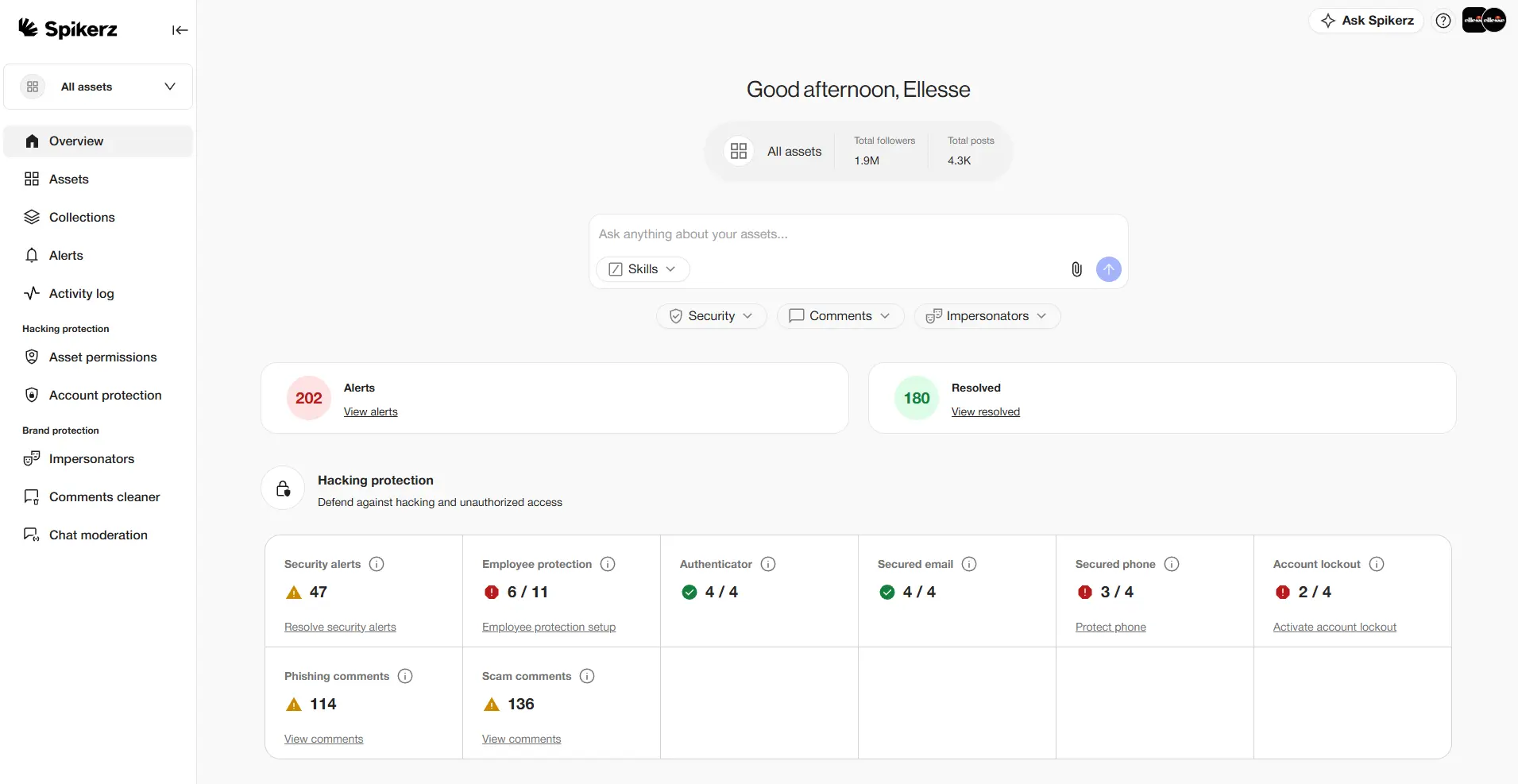
Spikerz is an all-in-one social media security and protection platform for businesses and content creators. It connects to Instagram, Facebook, WhatsApp, YouTube, X, and TikTok through official APIs in a few clicks, with no passwords or credentials shared.
It also scans for fake accounts every day using AI face detection and similarity models, then verifies and removes them before they reach your audience, with a 95%+ removal success rate on Meta.
Use this as your benchmark for good coverage across all the networks you use. Compare your current setup against it:
- Broad platform coverage: One place to protect your Instagram, Facebook, YouTube, TikTok, LinkedIn, and X accounts.
- Daily impersonator detection and takedown: Finds fake accounts using your brand assets, talent, or executives and manages the full impersonator takedown process, so profiles come down in hours or days.
- Contextual matching: Tells fan accounts and parody profiles apart from real threats, so your community stays safe.
- Comment and DM moderation: Automatically detects and removes scam replies and phishing links that attackers drop on your posts, across more than 25 languages.
- Account takeover protection: Locks down 2FA and provides secure team access so hackers can't seize your accounts or those of your employees.
- Permissions management: Controls who on your team can access each account from one place, and revokes access the moment someone leaves.
- Account backup and recovery: Always keeps a backup so a takeover or takedown doesn’t wipe out your online presence, plus we have a free recovery chatbot you can use to get you back in.
How much would it be worth to you to have a brand name your audience can always trust?
Every hour a fake account stays live, it slowly damages the trust you spent years building. Give your customers a name they never have to second-guess, and let Spikerz catch all the fakes before they do. Book a demo right now.
How to build an online brand protection strategy
- Map your brand: Start by listing every place your brand lives online; your social profiles, your domains, your marketplace listings, your app, and the ad accounts you are running.
- Rank each surface by risk: Weight each surface by where your customers actually get hurt. For most consumer brands in 2026, social carries the most loss and the fastest-growing impersonation, so it goes to the top.
- Protect your accounts first: Create strong, unique passwords and use two-factor authentication on every account, and implement role-based access. Remember that 2FA can still be phished or bypassed, so learn the most common signs that your account is hacked and keep monitoring for suspicious activity.
- Monitor for impersonation and scams daily: Search your brand name, handles, and executives' names for fakes, and watch your comments and DMs for scam links.
- Take down fast, then repeat: Finding a fake is only half the job; start by you reporting it, then track the takedown process. After that, move to the next one.
- Automate what doesn’t scale: Daily monitoring and takedown across every platform is more than any team can do manually, instead, automate it with a dedicated tool. Also, create a written brand protection policy so you know how to tackle account protection and comment and DM management. If you need some help creating it, download the 2026 social media security playbook. It’ll give your team the standard to run.
Who needs online brand protection, and how much does it cost?
There are two questions that always come up before any brand invests: do I really need this, and what does it cost?
Here are the answers to both:
Who needs it?
Online brand protection is essential for any brand people can be tricked into trusting (which is most of them). The clearest cases are:
- Consumer brands with an engaged audience.
- Creators, influencers, and public figures whose face and name are the product.
- Any brand that sells online.
- Small teams that don’t have the resources to manually monitor all their accounts.
How much does it cost?
Most vendors quote by scope, so pricing depends on how many accounts and platforms you wish to protect and which threats you want to cover.
Conclusion
Online brand protection covers five main areas (domains, market places, app stores, ads, and social media), but most monetary losses and impersonation happen on social media. What’s worse is that it’s the surface most brands focus on the least. The old playbook still covers domains and marketplaces, but it leaves social exposed.
If you are dealing with impersonators, account takeovers, and spam comments and DMs, use an automated platform like Spikerz that handles everything at a scale.