How To Manage Impersonation In Social Media


Summary:
Find out five ways attackers impersonate your brand on social media, from cloned profiles to full account hijacking, and why trust makes these scams so effective. Plus the 3-step takedown process to remove fake accounts fast, and how to shorten the window before they cause damage.
The sad truth is that a hacker only needs a few minutes to copy your logo, steal your profile photo, and create a fake account that looks exactly like yours. They then use it to run phishing scams, launch fake giveaways, or sell counterfeit goods to people who trust your brand. What’s worse is that most of your followers will never tell the difference between the impersonator and the real you.
In this post, we'll break down what social media impersonation is, the five types you need to watch for, and why these attacks succeed. Then we'll walk you through what to do if someone impersonates you, and how to stop the cycle for good.
What Is Social Media Impersonation?
Social media impersonation happens when someone creates an account that pretends to be you, your brand, or a member of your team. The goal is to trick your audience into trusting a stranger. Once that trust is in place, the attacker can steal money, harvest passwords, or spread lies.
For example, picture a fake Instagram account that copies your business name, bio, and profile picture. Then it follows your customers and sends them a direct message about a limited giveaway. After that, all they have to do is "verify" their card details on a linked page, and the scam is complete.
Types of Social Media Impersonation
Impersonation is not a single thing. It shows up in five main forms, and each one targets a different weak spot. Here are the five types you should know:
Personal Account Impersonation
Personal account impersonation targets an individual instead of a company. Attackers clone the profile of a creator, athlete, or public figure, then message that person's fans while wearing their face.
The music industry gets hit hard by this all the time. We broke down how fake artist profiles scam fans out of money and personal data in our report on the biggest social media threats facing the music industry. The way the scam works is simple: Fans believe they're talking to their favorite artist, so they hand over cash for concert tickets and merchandise that never ships.
Social Media Account Hijacking
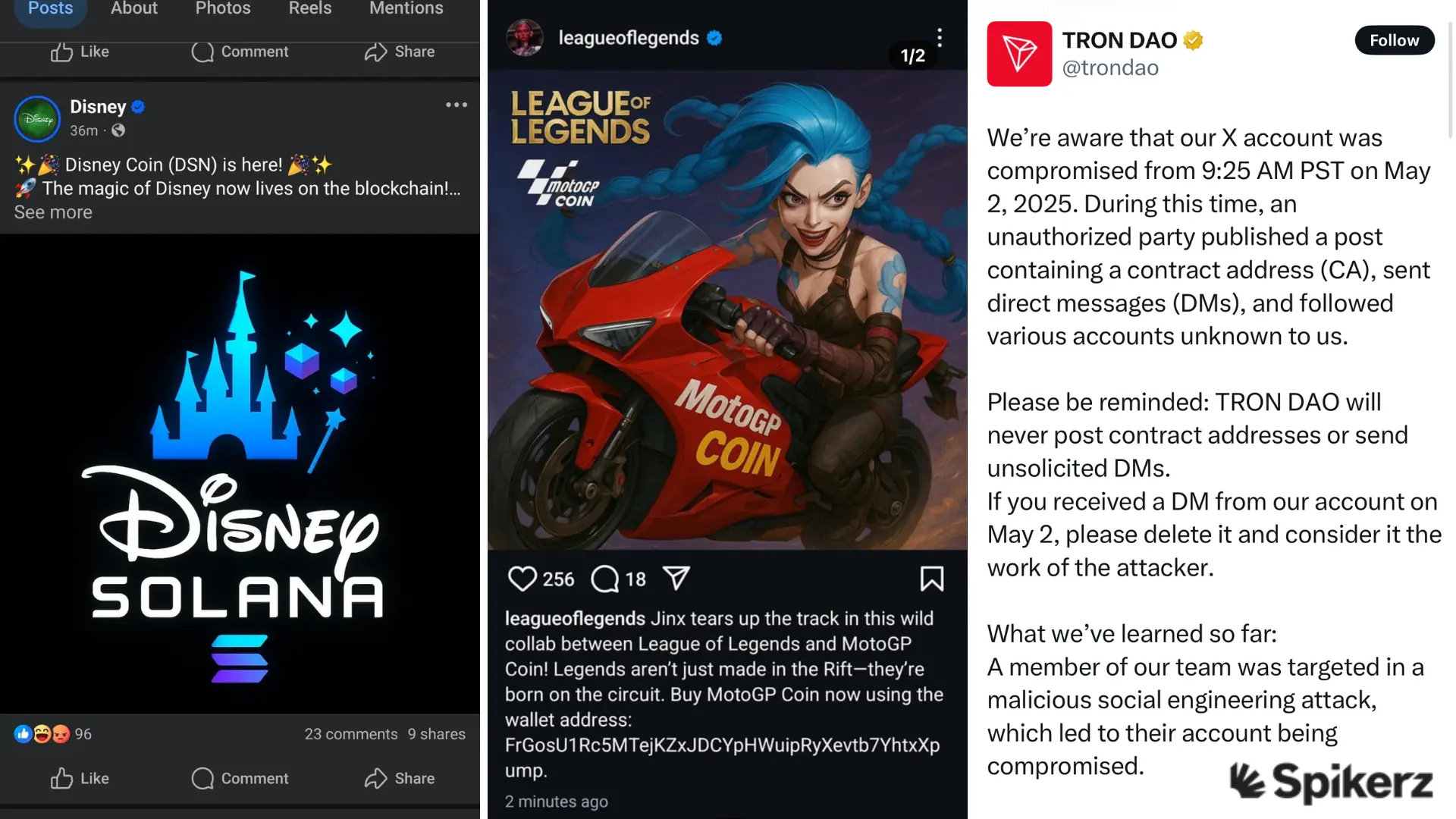
Account hijacking is different because the attacker doesn't build a copy. Instead, they steal the real thing. Once a hacker controls a verified business account, they rebrand it and point its audience toward a scam.
We see this all the time, a brand page suddenly starts pushing a crypto giveaway or a "limited drop," and thousands of real followers get burned before anyone regains control. The main issue here is that the account still carries the brand's history and blue check, which makes the con far more convincing.
Fake Accounts or Bots
Fake accounts and bots flood platforms with profiles built to impersonate brands and their customers at scale. The biggest issue with this threat is that one operator can run hundreds of them, so the problem grows fast.
For example, a common version is angler phishing. When a customer complains under a brand's post, a swarm of bot accounts posing as "official support" jumps in, sends a friendly reply, and links the customer to a fake login page. The customer then thinks they're getting help, but they're handing their password straight to an attacker.
Executive Impersonation
Executive impersonation (also called whaling) goes after the people at the top. Attackers pose as a CEO, CFO, or founder to pressure staff, partners, or customers into acting fast.
This is one of the most damaging attacks. For example, in 2024, a finance worker at the engineering firm Arup joined a video call with people who looked and sounded like the company's CFO and colleagues. The problem was that every one of them was a deepfake, and the worker approved transfers worth about $25 million before anyone caught the fraud.
Brand Impersonation
Brand impersonation copies your company itself: the name, the logo, the tone, and the verified badge if attackers can fake one. The aim is to borrow your reputation and spend it on a scam.
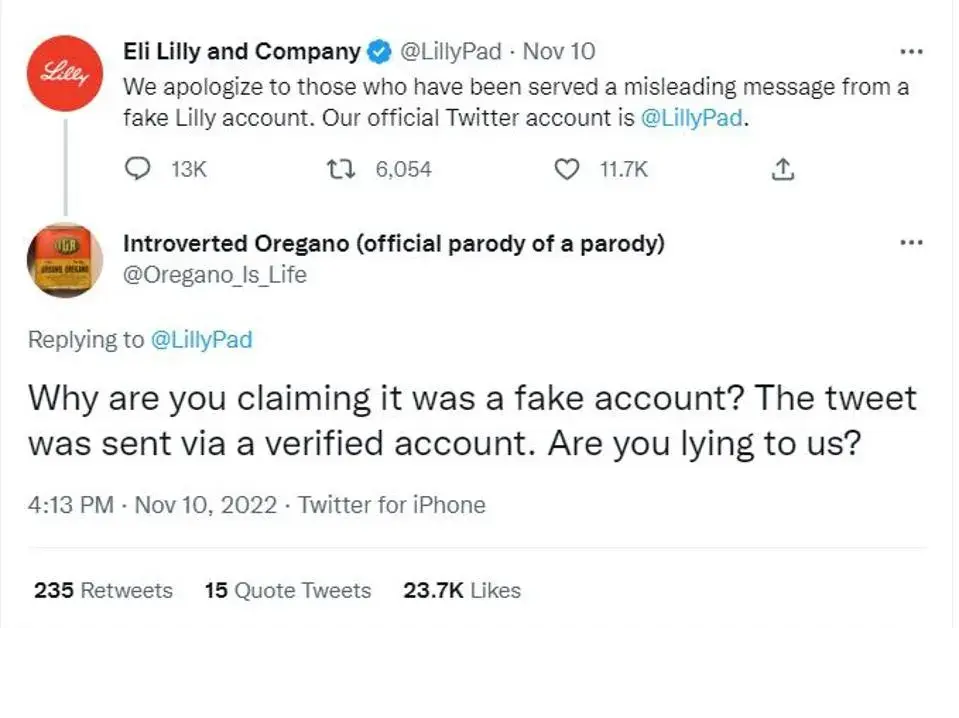
For example, in late 2022, after X opened paid verification to anyone, someone bought a blue check, copied the pharmaceutical company Eli Lilly, and posted that insulin was now free. The message spread across the platform, and the company's shares fell more than 4% while its team fought to correct the record. As you can see, one fake post, backed by an $8 badge, rattled a multi-billion-dollar company.
Why Does Social Media Impersonation Work So Well?
Impersonation works because it targets trust, not the technology itself. Your followers already believe in your brand, so a copy that looks right easily slips past their guard.
However, there's another reason these attacks keep rising. As companies locked down email with tools like SPF, DKIM, and DMARC, phishing over email got harder to pull off. Security firm Netcraft has tracked how attackers responded by shifting to social media, where impersonation is cheap, fast, and far less policed.
And after that, AI made the shift even worse. Free tools now clone voices, faces, and writing styles in minutes, which is why impersonation of employees and executives keeps climbing. The 2026 Workforce Impersonation Report from Nametag documents how this kind of attack has grown into one of the biggest threats a company faces.
How Hackers Take Over Social Media Accounts
Before an attacker can impersonate you from the inside, they need a way in. Most account takeovers start with one of a few reliable tricks.
The most common is a phishing email dressed up as the platform itself. You get a message claiming you violated community guidelines or need to verify your identity, and it pushes you to a fake login page that captures your password the moment you type it. We see this pattern in a large share of the hacks we investigate.
Other routes include SIM swapping to intercept text-based 2FA codes, malware that steals active session cookies, and third-party apps that request access and never let go. Reused passwords make it easy too, since one leaked login from an old breach can unlock several accounts at once. This is why 2FA alone no longer keeps you safe; attackers have learned to work around it.
What To Do If Someone Impersonates You on Social Media
Fighting back is more straightforward than you'd expect. If you find a fake account using your name, follow these three steps to take them down:
1) Make A List Of The Impersonators
Start by hunting down every fake account you can find and writing them all in one place. Search your brand name, common misspellings, and your executives' names across each platform.
A single list keeps you organized and ready to act fast. When you report the accounts, you can hand the platforms everything at once instead of chasing one profile at a time.
2) Gather Evidence
Next, collect proof that you own the real brand. Take screenshots of each fake profile, save the profile links, and pull together your trademarks, copyrights, and official account details.
Strong evidence is what turns a report into a removal. The clearer you make it that you're the rightful owner, the faster a platform will act.
3) Report Them To The Platform
Finally, use everything you gathered to file takedown requests with each platform. Submit the screenshots, links, and ownership proof through the official reporting channels.
Be patient here, because the process moves at a different speed on every platform. Some takedowns land in days, while others drag on for weeks as the fake accounts keep operating.
How To Speed Up The Process With Spikerz
Here's the hard truth: impersonation is a game of cat and mouse. You take down five fake accounts, and by next week ten more appear, forcing you to run the whole tiring process again.
The good news is that you don't have to run it alone. Spikerz is a social media security platform that handles the heavy lifting for you, so your team can focus on real work instead of chasing mice.
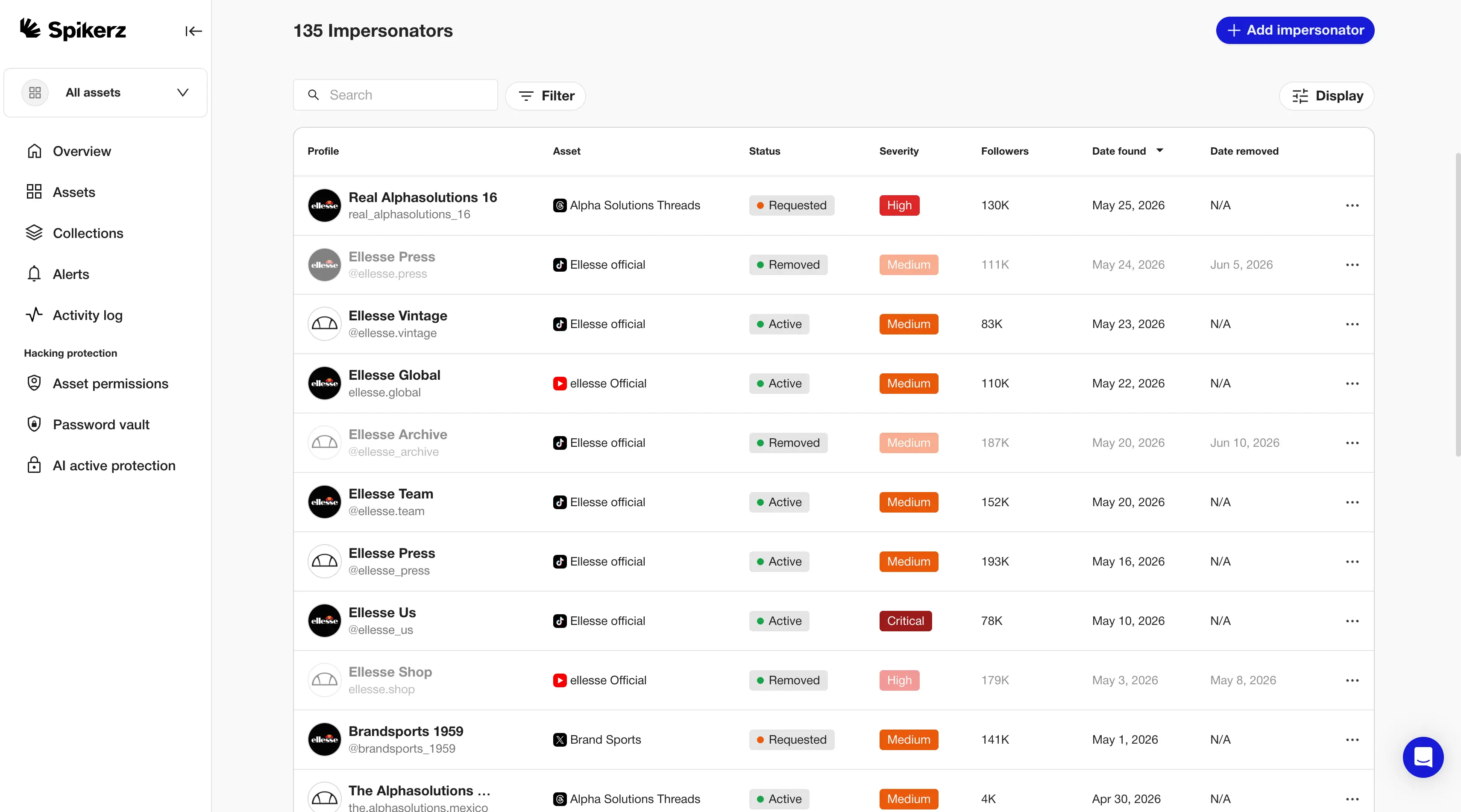
Our impersonation monitoring scans social platforms every day using AI face detection and similarity models, paired with contextual analysis that tells a real threat apart from a harmless fan page or parody. When we confirm an imposter, we verify it, escalate it, and drive the takedown through pre-built platform workflows. On Meta, that process removes more than 95% of impersonators, often in hours or days instead of months.
Why keep losing customers, sales, and sleep to accounts pretending to be you?
Book a demo right now and watch Spikerz find and remove the impersonators draining your time, while you win back the hours you spend on manual takedowns. Your audience should never have to wonder whether it's really you, and with Spikerz, they won't.
Conclusion
Social media impersonation isn't a minor annoyance you can wave off. It drains your revenue, scams the customers who trust you, and hands your hard-won reputation to strangers who never earned it.
You now know how these scams work, why they succeed, and the three steps to fight back: list the impersonators, gather your evidence, and report them to each platform. That process works, but it never truly ends, and doing it by hand costs you hours you can't get back.
You built your brand to be trusted, so protect it. Let Spikerz watch for fakes around the clock, so the only account your customers ever find is the real one. Book a demo right now and keep your name in your own hands.
