Why malware-free attacks are your biggest risk

Malware-free attacks make up 79% of detections, and antivirus tools often miss them, as the Bruno Fernandes X account hack showed. This guide gives eight steps, including authenticator apps, hardware keys, continuous monitoring and incident response, with a focus on identity and credentials.
Why malware-free attacks are your biggest risk now
Unfortunately, cyber attacks grow more aggressive with each passing year. What worked to protect your business last year won't be enough this year. The threat landscape changes constantly, and attackers develop new methods to bypass security measures faster than most companies can adapt.
Traditional security measures like antivirus software and firewalls were designed to catch malware. But what happens when attackers don't need malware at all?
Malware-free attacks are quickly becoming the preferred method for cybercriminals because they're harder to detect and prevent.
So in this post we'll explore how Bruno Fernandes' recent X account hack exposes a huge threat businesses face. You'll learn why malware-free attacks have surged to 79% of all detections. And we'll share eight actionable steps to protect your brand from these increasingly common attacks.
What happened to Bruno Fernandes' X account?

Manchester United captain Bruno Fernandes had his X account hijacked for several hours on January 11, 2026. The breach exposed his 4.5 million followers to cryptocurrency scams and offensive content.
The first post appeared at 11:12 pm on Sunday, with hackers writing "Join Macclesfield FC. Excited for the future." This referenced the National League North side that had just knocked out FA Cup holders Crystal Palace. This message seemed harmless at first but it was just the beginning of a series of tweets.
The situation escalated quickly as hackers posted increasingly explicit content. They made sexually charged comments about ex-teammate Cristiano Ronaldo, women's football star Alisha Lehmann, and adult content creator Bonnie Blue. The attackers also posted "joining England Cricket as they need all the help they can get" following England's 4-1 defeat to Australia in the Ashes.
Soon after, Manchester United issued an official statement addressing the breach. The club warned supporters: "Bruno Fernandes's X account has been hacked. Supporters should not engage with any of the posts or direct messages."
As you can see, this hack shows how quickly brands must act when accounts fall into the wrong hands.
Why should you pay attention to these attacks?
High-profile hacks like Bruno Fernandes' account aren't isolated incidents, we see hacks like this one all the time. That's because there's been a big increase in phishing attacks.
Knowbe4's 2025 Phishing Threat Trends Report found a 17.3% increase in phishing emails between September 15, 2024, and February 14, 2025 (compared to the previous six months).
But that's not all, attackers have also shifted their tactics away from traditional malware. Crowdstrike's 2025 Global Threat Report found that there's a need for cross-domain security strategies that account for identity compromise, lateral movement, and cloud-based attack vectors.

Malware-free attack techniques like social engineering have trended upward over the past five years. In fact in 2024, malware-free activity accounted for 79% of detections, a sharp rise from 40% in 2019. As you can see, this is something you have to consider as traditional security tools might miss the most common threats targeting your accounts.
You need to protect against all types of attack vectors, not just malware. Your security strategy must adapt to this reality or leave your accounts vulnerable to the same fate as Bruno Fernandes' X account.
How to effectively protect your brand on X
Bruno Fernandes didn't publicly share how attackers breached his account. However, security experts assume the attackers gained access through weak credentials or phishing tactics.
That said, there are effective ways to improve your security posture. Here are the best ways to improve your account's security and reduce your attack surface.
1) Use secure passwords
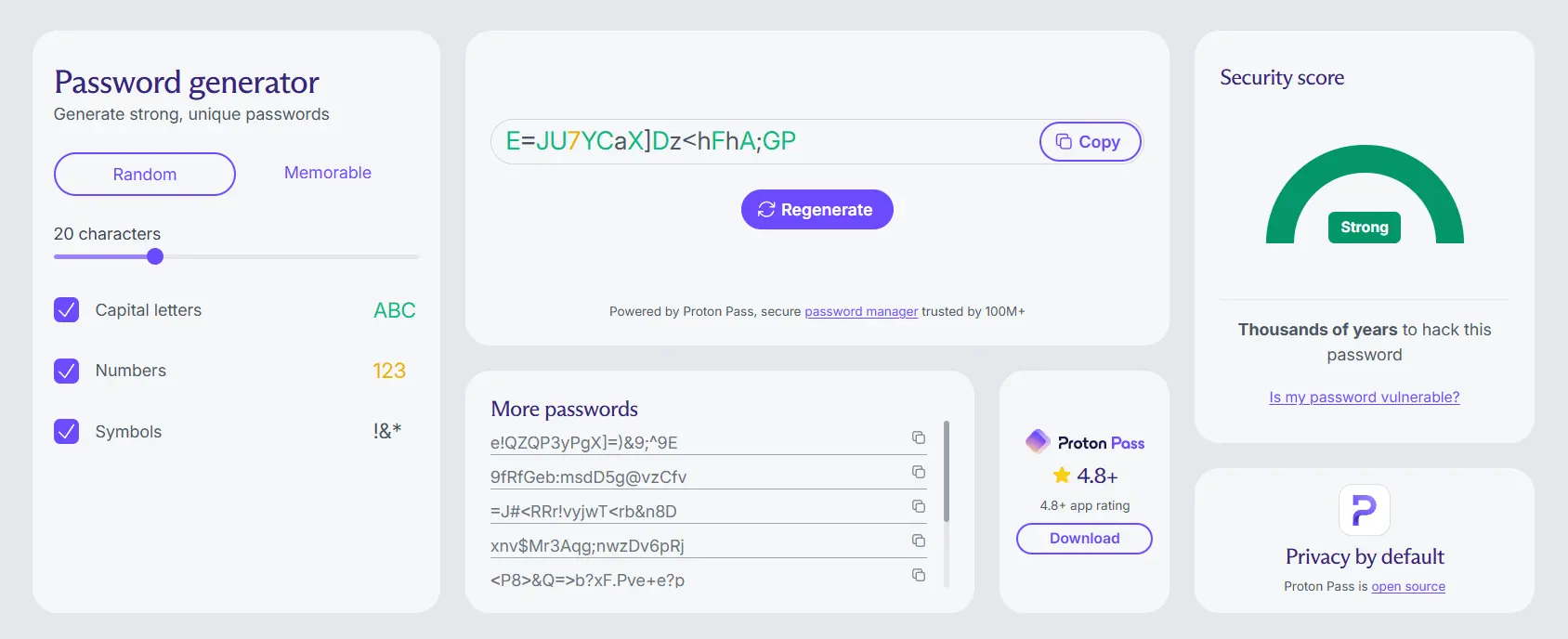
Strong passwords create the first barrier between attackers and your social media accounts. As such, if you use weak or reused passwords, you give hackers an easy entry point to compromise your accounts.
And that's precisely why you must always create passwords that are at least 20 characters long and include uppercase and lowercase letters, numbers, and special characters. Also, make sure to avoid using personal information like birthdays, names, or common words that attackers can guess.
Here are some further things you should consider:
- Use a unique password for each social media account to prevent one breach from affecting all your platforms.
- Never share passwords through email, text messages, or unsecured channels. If you need to share access with team members, use a company-approved password manager to store and share credentials securely. That way you ensure that even if someone leaves your organization, you maintain control over who has access to your accounts.
2) Use authenticator apps exclusively (never SMS for 2FA)
Two-factor authentication adds a second security layer that is extremely effective at blocking brute force attacks. However, many people use SMS as their authentication method, making it easier for attackers to intercept messages and codes.
So as a rule of thumb, never use SMS-based 2FA. Attackers can use malware to intercept text messages and they can even use methods like SIM swap attacks, where they convince your phone carrier to transfer your number to a device they control. Once they have access to your phone number, they receive your authentication codes and bypass your security.
Instead, use an authenticator app. Apps like Google Authenticator or Authy generate time-based codes that expire quickly and can't be intercepted like SMS. Just keep your authenticator app on a different device from where you access social media to reduce the likelihood of both being compromised at once.
3) Consider using hardware security keys for high-value accounts

Hardware security keys plug into your computer or connect via Bluetooth to verify your identity. The best thing is, attackers can't remotely steal or intercept the authentication signal from a hardware key so they provide the most secure 2FA method available.
A security key is a small USB device that you must physically insert or tap to verify your login. Services like YubiKey offer keys that work across multiple platforms and accounts. So consider using hardware security keys for your high-value accounts like verified X profiles, YouTube channels with monetization, or Instagram accounts with large followings.
That said, some teams need shared access to 2FA codes so a Yubikey wouldn't work for everyone. Instead, use 2FA for teams. It allows multiple authorized users to access the same authentication codes through a secure, centralized system.
So if you have multiple people managing your account, enable it for everyone. 2FA for teams lets you grant and revoke access as needed while maintaining the security benefits two-factor authentication offers.
4) Remove phone numbers from social accounts post-verification
Many platforms require phone verification during account setup, but you should remove the number immediately after verification. Leaving your phone number attached to your account gives attackers another avenue to compromise your security.
So go ahead and remove phone numbers from your account settings in X, Instagram, Facebook, and other platforms after initial verification. Check your security settings regularly to ensure no phone numbers remain associated with your accounts.
5) Revoke access when people leave your organization
A clear system for user access management prevents former employees and contractors from accessing your accounts. So revoke all account permissions immediately when team members leave your organization.
Check every platform where the departing employee or contractor had access and remove their credentials. This includes social media accounts, password managers, and any third-party tools connected to your accounts.
6) Monitor accounts, especially during high-visibility moments
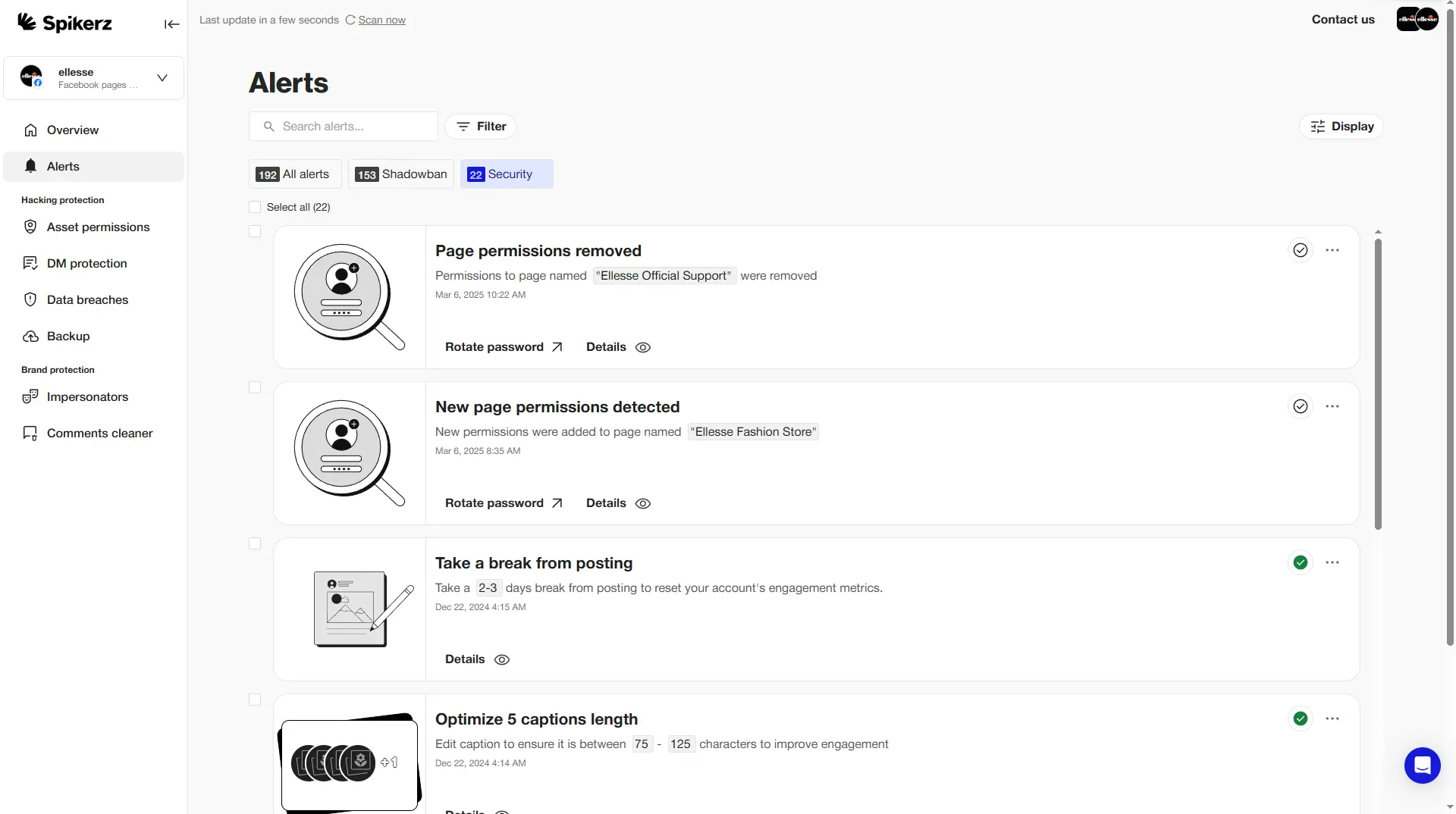
There are many ways to monitor your accounts, but the best approach is to use a social media security tool like Spikerz. These tools catch suspicious activity 24/7 without requiring your team to manually check accounts.
Here's how Spikerz protects your brand:
- Account Takeover Protection: Real-time monitoring detects unauthorized access attempts and login anomalies before attackers gain control of your accounts
- Phishing Prevention: AI-powered scanning identifies phishing attempts in direct messages and comments that try to steal credentials or sensitive information
- Impersonation Takedown: Automated detection finds fake accounts impersonating your brand and initiates takedown procedures to protect your reputation
- User Access Management: Centralized control over who has access to your accounts with easy permission revocation when team members change roles or leave
- Comment Moderation: Advanced filtering removes spam, bots, and harmful comments that could damage your brand image or expose followers to scams
Listen, your social media security determines whether you maintain control of your brand or hand it over to attackers. So go ahead and book a consultation of Spikerz right now to see how automated protection can secure your accounts before the next attack hits. We'll show you exactly where your current security gaps are and how to close them.
7) Use antivirus software to remove info stealers
Traditional antivirus software is essential for detecting and removing info stealers. Info stealers are a type of malware designed to extract saved passwords, session cookies, and authentication tokens from your browser and applications. Attackers then use stolen session cookies to bypass your email, password, and 2FA entirely.
That's why you should run regular antivirus scans on all devices that access your social media accounts.
8) Establish organizational protocols for fast incident response
The tips we shared above are all effective but not foolproof. For this reason you should always prepare for the worst case scenario so your team knows exactly how to respond during an account breach.
Having protocols in place means your team responds immediately rather than wasting critical time figuring out what to do. So go ahead and document who to contact, which passwords to change, and how to notify followers about the breach. Then, run through these protocols regularly so everyone knows their role when an incident happens.
If you want some help creating a social media policy, check this template right here. It'll provide you with everything you'll need to create your own policy.
Conclusion
Malware-free attacks are one of the biggest security threats facing your social media accounts. The reason is simple: these attacks bypass traditional security measures because they don't rely on malicious software. Attackers use your credentials obtained through phishing, social engineering, or credential stuffing to gain access to your accounts.
Bruno Fernandes' X account hack is a clear example of what happens when security fails. The breach exposed 4.5 million followers to scams and offensive content. More importantly, it shows that no account is too big or too important for attackers to target.
That's why your security strategy must account for the reality that 79% of attacks don't use malware. So do the following:
- Use strong passwords
- Use authenticator apps for 2FA (or hardware security keys)
- Use continuous monitoring to detect suspicious activity and block it.
The good news is that tools like Spikerz automate protection across multiple attack vectors so you can focus on building your brand instead of constantly watching for threats. Book a consultation right now to see how automated protection can secure your accounts before the next attack hits. We'll show you exactly where your current security gaps are and how to close them.
