5 Best Agorapulse Alternatives for Comment Moderation


Summary:
Discover which social media management platform best fits your moderation needs—whether you're managing high-volume comments, protecting against spam and phishing, or balancing publishing with community care. This guide breaks down five alternatives to Agorapulse, comparing their strengths so you can match the right tool to your specific challenge: light scheduling, customer support integration, rule-based automation, or AI-powered security. By the end, you'll know exactly which platform prevents problems versus which one simply reacts to them.
Agorapulse has earned its reputation as a solid tool for scheduling posts and managing a unified inbox. The reason is simple: Marketing teams like its calendar view, its reporting dashboards, and the way it keeps client communication organized in one place.
But when your comment volume spikes or your brand becomes a target for spam, scams, and phishing, its built-in moderation starts to show its limits.
The problem is speed. Agorapulse leans on manual review and basic keyword filters, which struggle against bot floods, multilingual spam, and AI-generated harassment. So if your team manages several high-engagement accounts, you’ll need automation that works while you sleep.
In this blog post we cover five Agorapulse alternatives built with stronger moderation capabilities. We’ll break down what each platform offers, who benefits most, and where each one fits in your stack.
1) Spikerz

Spikerz is a social media security platform that keeps brands safe from hacking, impersonators, phishing, and harmful comments. For example, our Comment Cleaner uses AI to scan your profiles around the clock, hiding spam, hate speech, scams, and phishing links before your followers ever see them.
Unlike general social management tools, we focus exclusively on protection. In other words, we provide context-aware detection across more than 25 languages, slang, and emojis, paired with custom rules you can define in plain English.
What Does Spikerz Have To Offer?
- Account takeover protection: Replaces shared passwords with centralized, secure logins and team-friendly 2FA, so hackers and former employees can’t slip into your accounts.
- Impersonator takedown: AI face detection and similarity models spot fake profiles impersonating your brand or executives, then our team handles the removal process for you.
- Phishing protection: Filters phishing attempts across DMs, comments, and emails, blocking malicious links before they reach your team or your customers.
- Comment moderation: Automatically detects and hides hate speech, spam, bots, and scams across Instagram, TikTok, Facebook, YouTube, LinkedIn, and X from one dashboard.
- Permissions management: Gives you full visibility over who has access to every account, with instant offboarding when someone leaves.
Who Benefits The Most From Using Spikerz?
Spikerz is best suited for brands, social media managers, agencies, and security teams that treat social media as a core revenue channel.
If your accounts attract high comment volume or you’ve been hit by impersonators, phishing campaigns, or account takeover attempts, our platform pays for itself fast.
Enterprise marketing teams that need IT-level governance over social accounts also get the audit trail and access controls their security teams require.
2) Hootsuite

Hootsuite is one of the oldest social media management platforms, widely known for its dashboard that lets teams monitor mentions, schedule content, and track brand sentiment in a single view. It works well as a central hub, but its moderation relies more on human reviewers than automation. That’s why teams that need hands-on control over community engagement often pair it with a dedicated filtering tool.
What Does Hootsuite Have To Offer?
- Reputation management: Tracks brand mentions, sentiment changes, and review sites so you can respond to issues before they grow.
- Market research: Surfaces audience trends, competitor activity, and industry conversations through its social listening tools.
- Social media management: Handles scheduling, publishing, and analytics across every major network from one dashboard.
Who Benefits The Most From Using Hootsuite?
Hootsuite suits mid-sized and enterprise marketing teams that want a single command center for publishing, listening, and reporting. Agencies managing multiple client accounts also benefit from its team permission structure and approval workflows.
3) Sprout Social

Sprout Social is a premium platform that combines publishing, engagement, and analytics with customer care tools. Its Smart Inbox pulls comments and DMs into one stream, and its rule-based automation hides or flags content based on keywords and patterns you set.
For example, for moderation, Sprout offers more depth than most general tools, with sentiment analysis and automated replies built in. Still, large brands dealing with coordinated spam attacks often need extra AI-powered filtering on top.
What Does Sprout Social Have To Offer?
- Social media management: Publishes, schedules, and organizes content across every major platform with approval workflows for teams.
- Social performance: Delivers detailed analytics on campaign results, audience growth, and post engagement.
- Team efficiency: Routes messages, assigns tasks, and tracks response times so support teams stay accountable.
- Social commerce: Connects product catalogs to social channels, letting teams tag products and track sales attribution.
- Brand awareness: Monitors mentions, trends, and share of voice across networks to measure brand health.
- Customer care: Combines social messaging, reviews, and helpdesk integrations into one support workflow.
Who Benefits The Most From Using Sprout Social?
Sprout Social works best for customer-service-heavy brands, retail companies, and enterprises that treat social as a primary support channel. Teams that need detailed reporting for executives and CRM integrations for sales also get strong value from the platform.
4) Buffer

Buffer started as a simple scheduler and has grown into a lightweight social media management tool aimed at small teams and solo creators. Its engagement features let you reply to comments from a unified inbox, with basic filtering to catch common spam patterns.
Buffer stays deliberately minimal, which is part of its appeal. If your brand faces heavy moderation needs, you’ll likely outgrow its filtering fast, but for smaller operations, it covers the basics without overwhelming users.
What Does Buffer Have To Offer?
- Social media management: Schedules posts across networks with a clean, calendar-style interface.
- Social media analytics: Tracks post performance, audience growth, and engagement.
- Content calendar: Organizes upcoming posts and campaigns visually so teams can plan weeks ahead.
- Community management: Brings comments and DMs into one inbox for quick replies.
- Team collaboration: Supports draft approvals, role assignments, and shared workspaces for small teams.
Who Benefits The Most From Using Buffer?
Buffer fits startups, small businesses, solopreneurs, and creator-led brands that need an affordable scheduling tool without the complexity of enterprise platforms.
Teams with moderate comment volume and minimal security concerns get the most value from its simplified workflow.
5) Statusbrew
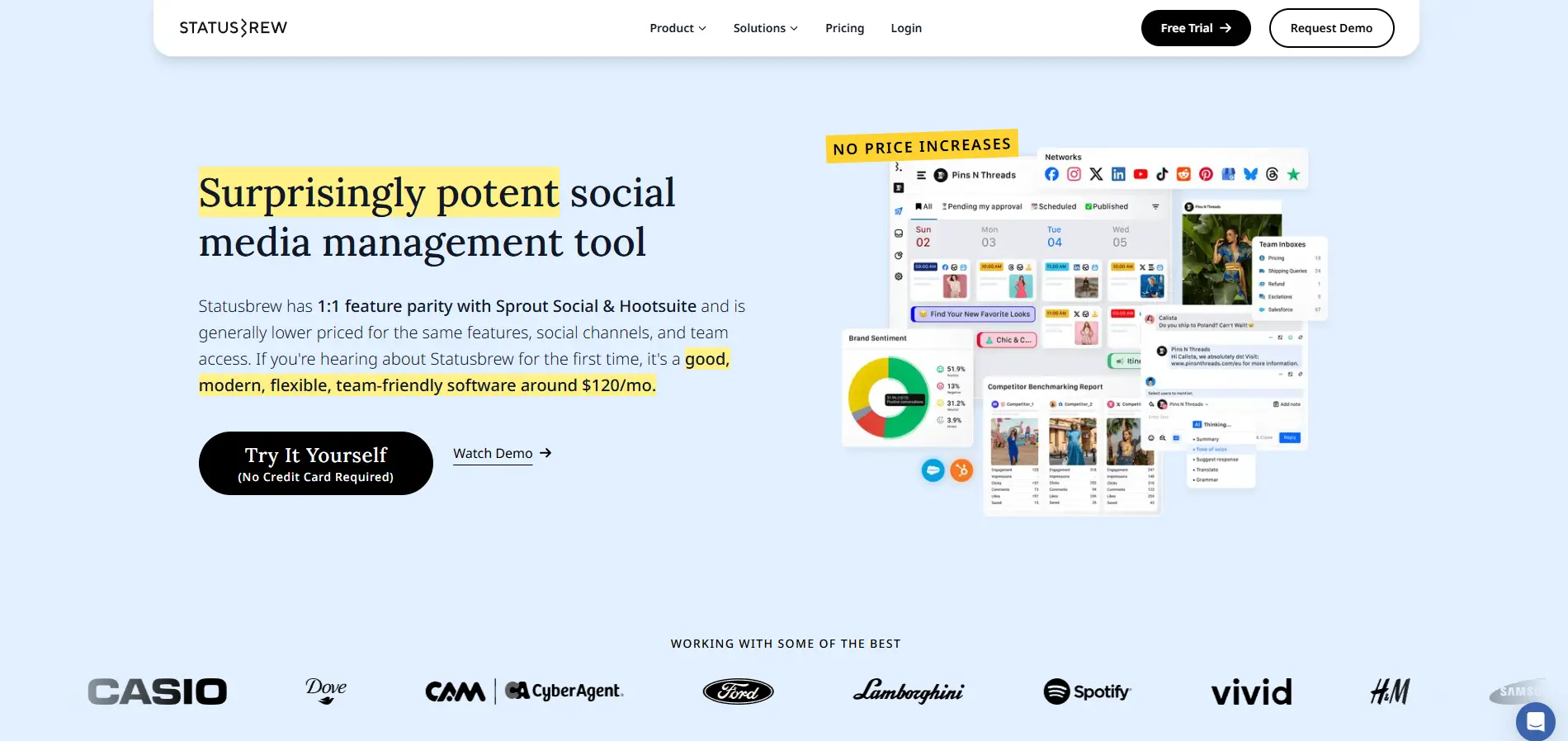
Statusbrew focuses heavily on community management, with rule-based automation that hides, deletes, or assigns comments automatically. Its moderation engine handles keyword lists, language detection, and bulk actions across platforms, which makes it better than most scheduling-first tools.
The platform markets itself to agencies and publishers that manage high-volume communities. From what we’ve seen, automation can reduce manual moderation work, though it still leans on keyword rules rather than deep AI context analysis.
What Does Statusbrew Have To Offer?
- Social media management: Publishes and schedules content across networks with approval workflows for agencies and enterprise teams.
- Community management: Automates comment moderation with rule-based filtering, bulk hiding, and assignment workflows.
- Social media analytics: Reports on engagement, audience growth, and team performance with customizable dashboards.
Who Benefits The Most From Using Statusbrew?
Statusbrew works well for agencies, publishers, and media brands that handle large comment volumes and need automation to keep up.
Also, teams that want rule-based moderation without building out a full security stack often land on Statusbrew as their go-to.
Conclusion
Choosing the right moderation tool depends on what your brand faces every day. For example:
- If your priority is scheduling with light moderation, Buffer and Hootsuite will serve you well.
- If you need deeper customer care and reporting, Sprout Social and Statusbrew are fantastic options.
- If your real challenge is protecting your brand from security threats hiding in your comments and DMs, a purpose-built platform like Spikerz will make a huge difference between reacting and preventing.
So go ahead and choose the platform that allows your brand to fix the issue you have and focus on the things that matter most to your business.
